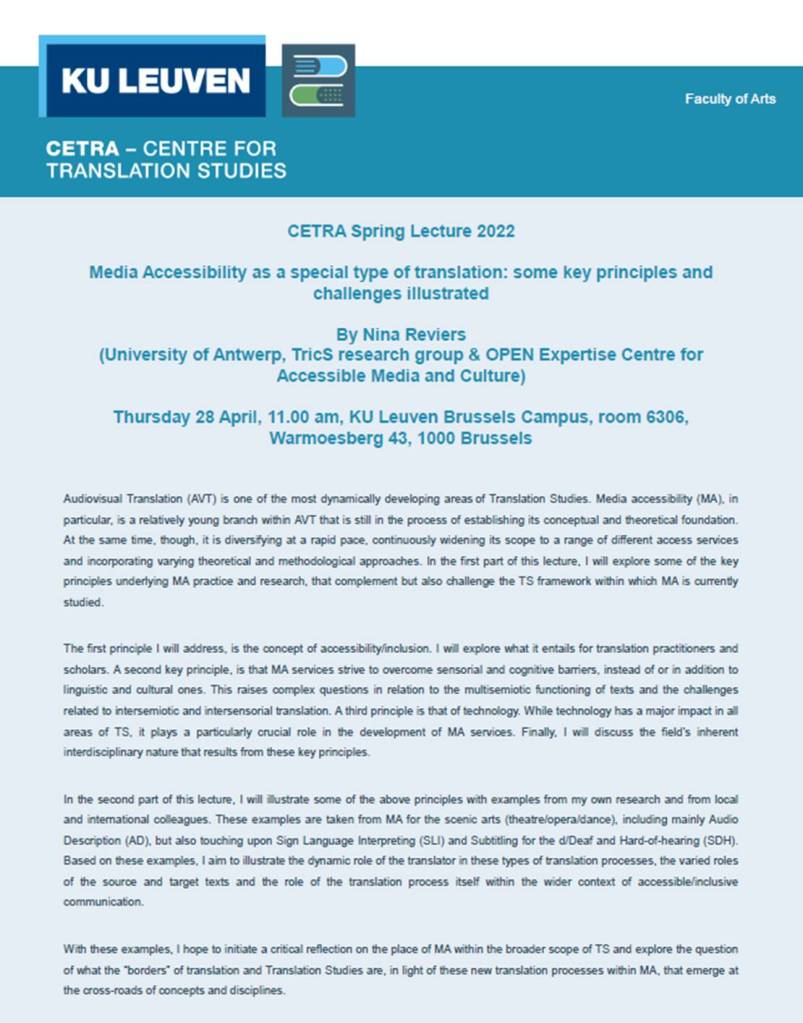
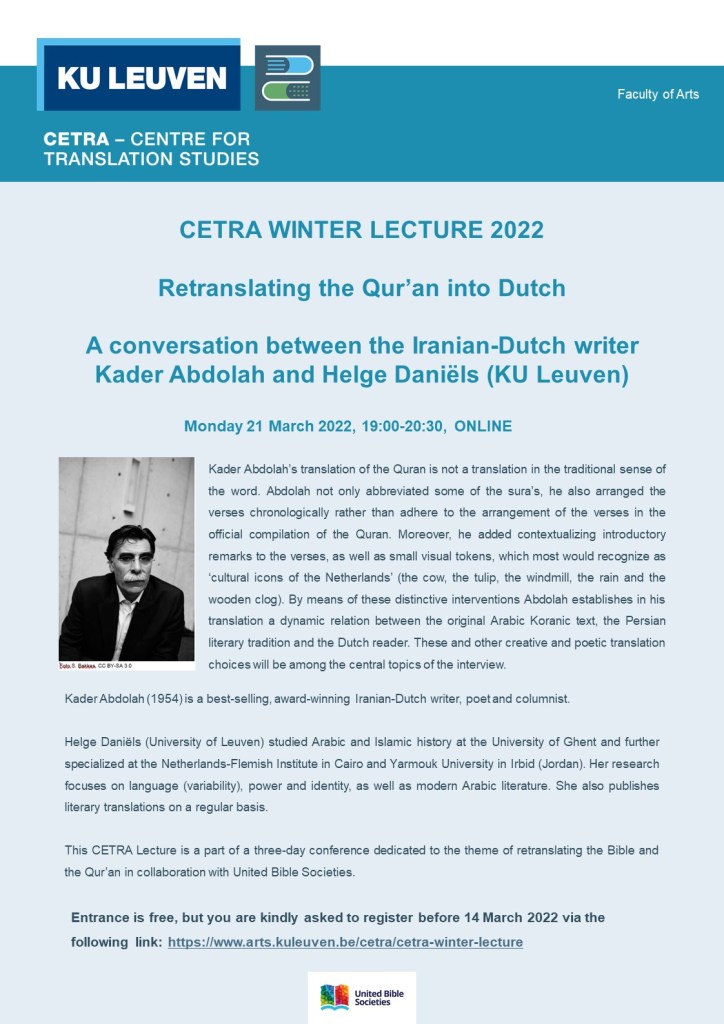
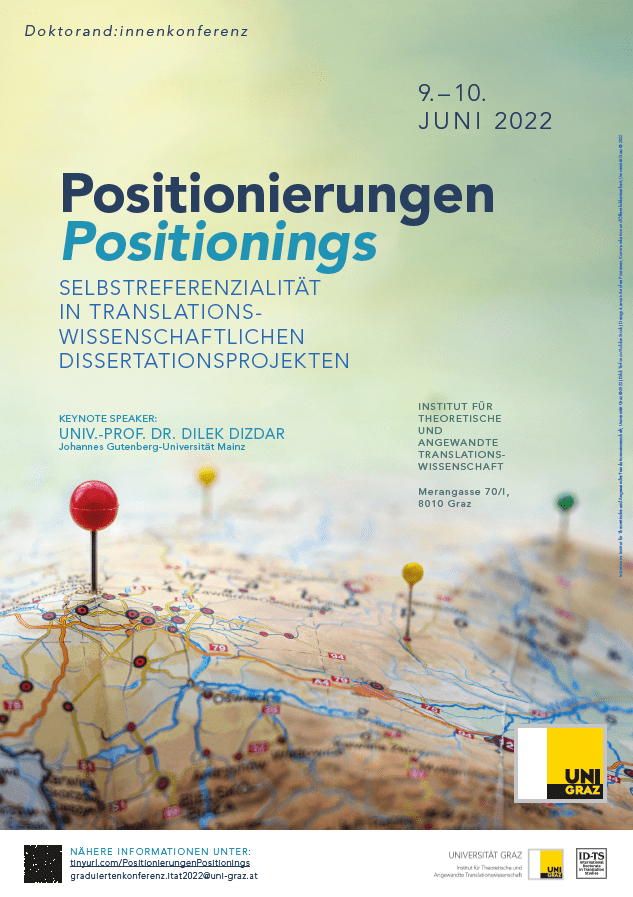
CETRA – Centre for Translation Studies is a leading centre for translation and interpreting research and researcher training based at KU Leuven, in Belgium. The CETRA Blog is a space for announcing events, lectures, conferences, job vacancies, calls and new publications of relevance to the CETRA community and translation studies scholars more generally. Share requests are welcome via cetra@kuleuven.be
Translation in Society (TRiS), the new journal dedicated to interdisciplinary research at the intersection of translation studies and the social sciences, is pleased to announce the publication of its inaugural issue, ‘Translating the Extreme’, with contributions from Brian James Baer, Salah Basalamah, Michael Cronin, Nicole Doerr and Beth Gharrity Garnder, David Inglis, and Luc van Doorslaer and Jack McMartin.
Translation in Society offers a platform for the growing amount of research in translation studies that draws on sociological theories and methodologies. It also seeks to contribute to the growing visibility of translation within the humanities and the social sciences more broadly, fostering new research that reveals the social relevance of translation in a wide variety of domains, while promoting at the same time self-reflexivity on the translational aspects of knowledge-production in disciplines such as sociology, political science, policy studies and anthropology.
Are you looking to place a piece of original research with TRiS? We are still accepting high-quality papers for issue 1:2, to be published later this year. For more on the inaugural issue, the scope of the new journal, or to submit a paper, see https://www.jbe-platform.com/content/journals/26673045
The University of Alicante is hosting the 5th International Conference on Economic, Business, Financial and Institutional Translation (https://dti.ua.es/en/tradeco/icebfit/) June 29-30, 2023.
The Centre for Translation Studies is seeking a University assistant (prae doc) in the field of Transcultural Communication (Prof. Dr. Cornelia Zwischenberger) with a focus on online collaborative translation (e.g. Translation Crowdsourcing, Fansubbing, Fandubbing, Scanlation, Translation hacking). These types of online collaborative translation are investigated as specific forms of transcultural communication where both the translation process as well as its product are characterized by particular hybridity. The Centre for Translation Studies (ZTW) at the University of Vienna, Austria is one of 20 academic units (faculties and centres) of the University of Vienna. In addition to the area of teaching (transcultural communication, translation studies, translation and interpreting education in 14 languages, etc.), the Centre conducts research in several key research areas. Cutting-edge research is conducted by professors, habilitated staff members, predoctoral and postdoctoral researchers, senior lecturers and many more. More than 120 lecturers teach translation-related subjects to about 3,000 undergraduate and postgraduate students.
The employment relationship is initially limited to 1.5 years and is automatically extended to a total of 4 years, unless the employer submits a declaration of non-renewal after a maximum of 12 months.
Tensions between Authoritative Translations and Retranslations in Theory and in Practice
KU Leuven, Belgium
Venue: online
CETRA – Centre for Translation Studies at KU Leuven, in collaboration with United Bible Societies, presents a three-day conference dedicated to the theme of retranslating the Bible and the Qur’an. Its aim is to bring together Translation Studies scholars and translators working with sacred writings, in particular Biblical and Quranic texts, and to stimulate the dialogue between theory and practice.
Program (version 7.2.2022)
Monday 21 March 2022
10:00-10:15 Word of welcome by Kris Van Heuckelom, Vice Dean for International Affairs, Faculty of Arts, and by organizers
Over the last two decades, research on retranslation has greatly expanded, partly under the influence of the so-called Retranslation Hypothesis (Chesterman 2000), based on the ideas by Berman (1990), claiming that retranslations tend to be more source-text-oriented than previous translations. The idea that translation is a process of improvement over time, from one translation to the next, coming closer and closer to the source text, has lately repeatedly been challenged and even undermined (Paloposki & Koskinen 2004). It is striking that research on retranslation has mainly focused on translations of literary source texts with a ‘canonized’ or ‘canonical’ status such as Shakespeare (e.g., Hanna 2009), Joyce (e.g. Alevato do Amaral 2019, Peeters 2016, Peeters & Sanaz Gallego 2019) and Dostoevsky (e.g., Boulogne 2018). Drawing on recent theoretical insights into retranslation (e.g., Deane-Cox Sharon 2014, Alvstad & Assis Rosa 2015, Peeters 2016, Van Poucke 2017) and on concrete case-studies, this conference wants to explore the theoretical and practical implications of the field of tension that exists between translations and retranslations when ‘canonized’ or ‘canonical’ writings in the literalsense of the word are at stake.
In doing so, the conference wants to shed light on the complex triangular relationships between a given sacred source text, its previous translations and new translations. Special attention will be given to the opportunities, pitfalls and challenges of retranslating a Biblical text or Quranic text (Abdel Haleem 2005, Allaithy 2014) – typical examples of highly sensitive texts (Simms 1998) – in the present time. A key issue that we propose for discussion in this respect concerns retranslations of canonical texts for which authoritative or indeed canonized translations already exist. Taking into account insights of narrative theory (Baker 2006, Brownlie 2006), we want to investigate which opportunities retranslation offers to counter, undermine or strengthen the existing narratives in the case when not only the source text, but also a given pre-existing translation has been attributed canonical status. How, for instance, can translators challenge the King James Version of the Bible, the Revised Standard Version, the Roman Catholic version, or the Jehovah Witnesses Version? On the other hand, in the case of the Qur’an, it seems that there is no such thing as an established or authoritative translation, let alone a canonical translation. What then is the historical and/or contemporary status of the numerous existing interlingual and intralingual translations of the Qur’an, both in and outside of the Islamic world? Are they merely pragmatic solutions to make the source text more widely or more easily accessible, or do they fulfill other functions (literary, ideological, theological, explanatory and other) as well?
The main issues we would like to discuss are related, but not limited, to the following topics:
Motives for the retranslation of sacred texts. How do issues such as ageing, changing contexts of reception, and reinterpretation impact on retranslations of the Bible, the Qur’an and other sacred writings? To what extent does the practice of retranslating sacred texts confirm or undermine the above mentioned retranslation hypothesis?
Strategies for retranslating sacred texts. How does the canonized nature of a given text (original or translation) influence the adopted retranslation strategies? How does the canonical nature of an already existing translation influence retranslation strategies? Which concrete retranslation strategies do translators of the Bible, the Qur’an and other sacred writings adopt? Which micro-textual (syntax, lexicon, terminology, etc.) and macro-textual choices are made? How can translators of the Bible and the Qur’an deal, both theoretically and in practice, with, among others, problems of sensitivity, intralingual translation, modernization versus archaisation, explicitness versus implicitness, denotation versus connotation, literarity versus functional equivalence?
The reception of retranslations of sacred texts. How can we evaluate the success of a given retranslation of the Bible, the Qur’an or other sacred writings? What makes some retranslations more successful than others? What role do various agents play in the canonization process of retranslations of sacred writings? What functions do the intralingual and interlingual retranslations or sacred writings fulfill in the different receiving contexts? How can the assumed lack of authoritative translations of the Qur’an be explained and challenged? How is it possible to compete with established translations of the Bible and the Qur’an? How to account for the unsuccessful reception of some retranslations? What paratextual and other strategies are used to put a retranslation in the market?
Keynote lectures
The Iranian-Dutch writer Kader Abdolah: ‘Retranslating the Qur’an into Dutch. A conversation with Helge Daniëls (KU Leuven)’
Ahmed Allaithy (American University of Sarjah): ‘Found in Translation ‒ The Untranslatable Qur’an’
Paraskevi Arapoglou (Hellenic Bible Society): ‘The curious case of LXX in Greek Orthodoxy: Retranslating within linguistic “dimorphia”’
Alexandra Assis Rosa (University of Lisbon): ‘Retranslating Theory and Canonical Texts’
Henri Bloemen (KU Leuven): ‘Retranslating the Bible and the Qur’an as Sensitive Texts’
Sameh Hanna (Leeds University): ‘Retranslation and the re-definition of an ‘authoritative translation’: sociological insights from the Arabic translations of the Bible’
Lourens De Vries (VU Amsterdam): ‘The retranslation of holy texts in Christian traditions: questions of authority, actualization and intertextuality’
Alexey Somov (Institute for Bible Translation, Russia, Moscow): ‘The Authority of the Old for producing the New: Bible Translations in Russia in the 21st Century’
Abdel Haleem, Muhammad A.S. (2005). The Qur’an, A New Translation. Oxford: Oxford University Press.
Alevato do Amaral, Vitor. (2019). Broadening the notion of retranslation. Cadernos de Traduçao 39:1. 239-259.
Allaithy, Ahmed. (2014). Qur’anic Term Translation: A semantic Study from Arabic Perspective. Antwerp: Garant.
Alvstad, Cecilia and Alexandra Assis Rosa. (2015). Voice in retranslation. An overview and some trends. International Journal of Translation Studies 27:1. 3-24.
Baker, Mona. (2006). Translation and Conflict. A Narrative account. London and New York: Routledge.
Berman, Antoine. (1990). La retraduction comme espace de la traduction.Palimspsestes 4 (Retraduire, edited by Paul Bensimon and Didier Coupaye). 1-7.
Boulogne, Pieter. (2019). And now for something completely different … Once again the same book by Dostoevsky: A (con)textual analysis of early and recent Dostoevsky retranslations into Dutch. Cadernos de Tradução. Edição Regular Temática – Retranslation in Context. 39:1. 117-144.
Brownlie, Siobhan. (2006). Narrative Theory and Retranslation Theory. Across Languages and Cultures 7:2. 145-170.
Chesterman, Andrew. (2000). A causal model for translation studies. In: Intercultural Faultlines. Research Models in Translation Studies I : Textual and Cognitive Aspects, edited by Maeve Olohan. Manchester: St. Jerome. 15-27.
Collombat, Isabelle. (2004). Le XXIe siècle : l’âge de la retraduction. Translation Studies in the New Millennium 1-15.
Deane-Cox, Sharon. (2014) Retranslation: Translation, Literature and Reinterpretation. London: Bloomsbury.
Desmidt, Isabelle. (2009). (Re)translation revisited. Meta 54:4. 669-683.
Gambier, Yves. (1994). La retraduction, retour et détour. Meta 39:3. 413-417.
Gambier, Yves. (2011) La retraduction: ambiguïtés et défis. Autour de la retraduction. Perspectives littéraires européennes, edited by Enrico Monti & Peter Schneyder. Orizons. 49-66.
Hanna, Sameh. (2009). Othello in the Egyptian Vernacular: Negotiating the ‘doxic’ in Drama Translation and Identity Formation. The Translator: studies in intercultural communication. 15: 1. 157-178
Izutsu, Toshihiko. (2001). Ethico-Religious Concepts in the Qur’an. Montreal: McGill-Queens University Press.
Koskinen, Kaisa. (2019). Revising and retranslating. In: Routledge Handbook of Literary Translation, edited by Kelly Washbourne & Ben Van Wyke. Routledge. 315-324.
Koskinen, Kaisa & Paloposki, Outi. (2015). Anxieties of influence. The voice of the first translator in retranslation. Target 27:1. 25-39.
Leutzsch, Martin. (2019). Übersetzungstabus als Indikatoren normativer Grenzen in der Geschichte der christlichen Bibelübersetzung. In: Übertragungen heiliger Texte in Judentum, Christentum und Islam. Fallstudien zu Formen und Grenzen der Transposition, edited by K. Heyden & H. Manuwald, Hermeneutische Untersuchungen zur Theologie Tübingen: Mohr Siebeck. 33-62.
Liss, Hanna. (2019). Wort – Klang – Bild: Zur (Un-)Übersetzbarkeit heiliger Texte im Judentum. In: Übertragungen heiliger Texte in Judentum, Christentum und Islam. Fallstudien zu Formen und Grenzen der Transposition, edited by K. Heyden & H. Manuwald, Hermeneutische Untersuchungen zur Theologie Tübingen: Mohr Siebeck. 19-32.
Paloposki, Outi & Koskinen, Kaisa. (2004). Thousand and One Translations: Retranslation Revisited. In: Claims, Changes, and Challenges, edited by Gyde Hansen et al., John Benjamins. 27-38.
Peeters, Kris (2016). Traduction, retraduction et dialogisme. Meta 61:3, 629-649.
Peeters, Kris & Sanz Gallego, Guillermo (2019, to appear). Translators’ creativity in the Dutch and Spanish (re)translations of “Oxen of the Sun”: (re)translation the Bakhtinian way. In: European Joyce Studies, edited by Erika Mihálycsa & Jolanta Wawrzycka. (Re)Translating Joyce in/for the 21st-Century.
Pink, Johanna. (2019). Text, Auslegung, Ritus. Kontroversen um die richtige und falsche Übersetzung des Korans am Beispiel Indonesien. In: Übertragungen heiliger Texte in Judentum, Christentum und Islam. Fallstudien zu Formen und Grenzen der Transposition, edited by K. Heyden & H. Manuwald. Hermeneutische Untersuchungen zur Theologie Tübingen: Mohr Siebeck. 63-89.
Simms, Karl. (1997). Translating Sensitive Texts: Linguistic Aspects (Approaches to Translation Studies 14). Brill/Rodopi.
Topia, André. (2004). Retraduire Ulysses : le troisième texte. Palimpsestes 129-151.
Van Poucke, Piet. (2017). Aging as a motive for literary translation. A survey of case studies on retranslation. Translation and Interpreting Studies. 12:1. 91-115.
Venuti, Lawrence (2004). Retranslations: the creation of value. Bucknell Review 47: 1. 25-38.
The Centre for Translation Studies of the University of Vienna is seeking a University assistant in the field of Transcultural Communication (Prof. Dr. Cornelia Zwischenberger) with a focus on online collaborative translation (e.g. Translation Crowdsourcing, Fansubbing, Fandubbing, Scanlation, Translation hacking).
In 1989 José Lambert created a special research program in Translation Studies at the University of Leuven in order to promote research training in the study of translational phenomena and to stimulate high-level research into the cultural functions of translation. Since then, this unique program has attracted talented PhD students, postdocs and young scholars who spend two weeks of research under the supervision of a team of prominent scholars as well as of the supervision of the Chair Professor, an annually appointed expert in the field of Translation Studies. From 1989 on, the program has hosted participants from Austria to Australia, from Brazil to Burundi, and from China to the Czech Republic.
The list of CETRA professors may serve as an illustration of the program’s openness to the different currents in the international world of Translation Studies: †Gideon Toury (Tel Aviv, 1989), †Hans Vermeer (Heidelberg, 1990), Susan Bassnett (Warwick, 1991), †Albrecht Neubert (Leipzig, 1992), Daniel Gile (Paris, 1993), Mary Snell-Hornby (Vienna, 1994), †André Lefevere (Austin, 1995), Anthony Pym (Tarragona, 1996), Yves Gambier (Turku, 1997), Lawrence Venuti (Philadelphia, 1998), Andrew Chesterman (Helsinki, 1999), Christiane Nord (Magdeburg, 2000), Mona Baker (Manchester, 2001), Maria Tymoczko (Amherst, Massachusetts, 2002), Ian Mason (Edinburgh, 2003), Michael Cronin (Dublin, 2004), †Daniel Simeoni (Toronto, 2005), Harish Trivedi (Delhi, 2006), †Miriam Shlesinger (Tel Aviv, 2007), Kirsten Malmkjaer (London, 2008), †Martha Cheung (Hong Kong, 2009), Sherry Simon (Montreal, 2010), Christina Schaeffner (Aston, 2011), Franz Pöchhacker (Vienna, 2012), Michaela Wolf (Graz, 2013), Arnt Lykke Jakobsen (Copenhagen, 2014), Judy Wakabayashi (Kent, USA, 2015), Jeremy Munday (Leeds, 2016), Leo Tak-hung Chan (Hong Kong, 2017), Sandra Louise Halverson (Bergen, 2018), Jemina Napier (Edinburgh, 2019), Brian James Baer (Ohio, 2021).
Basic activities and components of the Research Summer School:
Public Lectures by the CETRA Professor on key topics. A preliminary reading list will be provided and all topics are to be further developed in discussions
Theoretical-methodological seminars given by the CETRA staff. Basic reading materials will be made available in advance
Tutorials: individual discussions on participants’ research with the CETRA Professor and the CETRA staff
Workshops in small groups according to topic or methodology
Students’ papers: presentation of participants’ individual research projects followed by open discussion
Publication: each participant is invited to submit an article based on the presentation, to be refereed and published in an edited volume
Co-organized by CETRA (KU Leuven) and Centre for Translating Cultures (University of Exeter)
Wednesday 8 December 4.30 pm Brussels time, 3.30 pm UK time Online (Microsoft Teams)
Professor Inghilleri’s lecture will consider art forms as modes of translation and instruments of communication that give voice to the experience of migration and displacement. It will examine three different media in which these phenomena are represented: prison writing, painting and photography. The featured works include the groundbreaking book No Friend But the Mountains, Behrouz Boochani’s account of long-term detention in Manus Island, one of Australia’s offshore island prisons, painter Jacob Lawrence’s The Migration Series which documented the migration of African Americans from the southern US to northern and western cities, and photographer Dorothea Lange’s Depression-era photographs of migrant farmworkers taken under the aegis of the US government’s Farm Security Association. Drawing on Barthes’ Camera Lucida (1981), Inghilleri argues that, despite their own challenges of denotation, these art forms avoid some of the problems of signification that arise when migrants’ stories are presented though truncated written or spoken narratives in the context of politicized and bureaucratised procedures.