CETRA – Centre for Translation Studies is a leading centre for translation and interpreting research and researcher training based at KU Leuven, in Belgium. The CETRA Blog is a space for announcing events, lectures, conferences, job vacancies, calls and new publications of relevance to the CETRA community and translation studies scholars more generally. Share requests are welcome via cetra@kuleuven.be
The Centre for Translation Studies of the University of Vienna is seeking a University assistant in the field of Transcultural Communication (Prof. Dr. Cornelia Zwischenberger) with a focus on online collaborative translation (e.g. Translation Crowdsourcing, Fansubbing, Fandubbing, Scanlation, Translation hacking).
In 1989 José Lambert created a special research program in Translation Studies at the University of Leuven in order to promote research training in the study of translational phenomena and to stimulate high-level research into the cultural functions of translation. Since then, this unique program has attracted talented PhD students, postdocs and young scholars who spend two weeks of research under the supervision of a team of prominent scholars as well as of the supervision of the Chair Professor, an annually appointed expert in the field of Translation Studies. From 1989 on, the program has hosted participants from Austria to Australia, from Brazil to Burundi, and from China to the Czech Republic.
The list of CETRA professors may serve as an illustration of the program’s openness to the different currents in the international world of Translation Studies: †Gideon Toury (Tel Aviv, 1989), †Hans Vermeer (Heidelberg, 1990), Susan Bassnett (Warwick, 1991), †Albrecht Neubert (Leipzig, 1992), Daniel Gile (Paris, 1993), Mary Snell-Hornby (Vienna, 1994), †André Lefevere (Austin, 1995), Anthony Pym (Tarragona, 1996), Yves Gambier (Turku, 1997), Lawrence Venuti (Philadelphia, 1998), Andrew Chesterman (Helsinki, 1999), Christiane Nord (Magdeburg, 2000), Mona Baker (Manchester, 2001), Maria Tymoczko (Amherst, Massachusetts, 2002), Ian Mason (Edinburgh, 2003), Michael Cronin (Dublin, 2004), †Daniel Simeoni (Toronto, 2005), Harish Trivedi (Delhi, 2006), †Miriam Shlesinger (Tel Aviv, 2007), Kirsten Malmkjaer (London, 2008), †Martha Cheung (Hong Kong, 2009), Sherry Simon (Montreal, 2010), Christina Schaeffner (Aston, 2011), Franz Pöchhacker (Vienna, 2012), Michaela Wolf (Graz, 2013), Arnt Lykke Jakobsen (Copenhagen, 2014), Judy Wakabayashi (Kent, USA, 2015), Jeremy Munday (Leeds, 2016), Leo Tak-hung Chan (Hong Kong, 2017), Sandra Louise Halverson (Bergen, 2018), Jemina Napier (Edinburgh, 2019), Brian James Baer (Ohio, 2021).
Basic activities and components of the Research Summer School:
Public Lectures by the CETRA Professor on key topics. A preliminary reading list will be provided and all topics are to be further developed in discussions
Theoretical-methodological seminars given by the CETRA staff. Basic reading materials will be made available in advance
Tutorials: individual discussions on participants’ research with the CETRA Professor and the CETRA staff
Workshops in small groups according to topic or methodology
Students’ papers: presentation of participants’ individual research projects followed by open discussion
Publication: each participant is invited to submit an article based on the presentation, to be refereed and published in an edited volume
Co-organized by CETRA (KU Leuven) and Centre for Translating Cultures (University of Exeter)
Wednesday 8 December 4.30 pm Brussels time, 3.30 pm UK time Online (Microsoft Teams)
Professor Inghilleri’s lecture will consider art forms as modes of translation and instruments of communication that give voice to the experience of migration and displacement. It will examine three different media in which these phenomena are represented: prison writing, painting and photography. The featured works include the groundbreaking book No Friend But the Mountains, Behrouz Boochani’s account of long-term detention in Manus Island, one of Australia’s offshore island prisons, painter Jacob Lawrence’s The Migration Series which documented the migration of African Americans from the southern US to northern and western cities, and photographer Dorothea Lange’s Depression-era photographs of migrant farmworkers taken under the aegis of the US government’s Farm Security Association. Drawing on Barthes’ Camera Lucida (1981), Inghilleri argues that, despite their own challenges of denotation, these art forms avoid some of the problems of signification that arise when migrants’ stories are presented though truncated written or spoken narratives in the context of politicized and bureaucratised procedures.
Translating ‘grey literature’ and the role of institutional and legal translators
This edited volume documents the state of the art in research on translation policies in legal and institutional settings. Offering case studies of past and present translation policies from several parts of the world, it allows for a compelling comparison of attitudes towards translation in varying contexts.The book highlights the virtues of integrating different types of expertise in the study of translation policy: theoretical and applied; historical and modern; legal, institutional and political. It effectively illustrates how a multidisciplinary perspective furthers our understanding of translation policies and unveils their intrinsic link with topics such as multilingualism, linguistic justice, minority rights, and citizenship. In this way, each contribution sheds new light on the role of translation in the everyday interaction between governments and multilingual populations. Look inside > Open Access ebook, ePDF 9789461664112, ePub 9789461664105 Paperback, € 27,00, ISBN 9789462702943, 15,6 x 23,4 cm, 288 p, Translation, Interpreting and Transfer 6
Translation, Interpreting and Transfer takes as its basis an inclusive view of translation and translation studies. It covers research and scholarly reflection, theoretical and methodological, on all aspects of the core activities translation and interpreting, but also similar rewriting and recontextualisation practices such as adaptation, localisation, transcreation and transediting, keeping Roman Jakobson’s inclusive view on interlingual, intralingual and intersemiotic translation in mind. The title of the series, which includes the more encompassing concept of transfer, reflects this broad conceptualisation of translation matters.Through its Research Summer School and other activities, CETRA (Centre for Translation Studies) has a reputation in supporting young researchers unfold their potential and in fostering excellence. Besides monographs and edited volumes from established researchers, this series particularly welcomes proposals from PhD candidates and early-career researchers, English translations of PhD theses in other languages, and CETRA Summer School papers. For more information, visit www.lup.be/TIT
Organizers: Núria Codina and Beatrijs Vanacker (KU Leuven)
Keynote Speakers: Rebecca Braun (NUI Galway) & Hilary Brown (Birmingham)
As the Romantic notion of the author as a male solitary genius is losing currency and being reformulated by scholars and writers alike, the role of gender in collaborative practices has come increasingly into the spotlight. Despite this growing interest, most studies focus on a particular historical period, most notably the contemporary era or the nineteenth-century. Although historical studies are gaining ground, especially on networks of female writers and translators in the modern period, we lack comparative analyses that help us better understand the continuities and changes that collaborations underwent across time and the role that gender plays in these processes. In addition, most studies are restricted to a single form of collaboration (networks, overt co-authorship or co-signature, implicit collaborations) or to a particular domain (academia, literary production, translation, circulation, reception). As a result, we lack insights into the – sometimes conflictual – relationships between the multiple practices, agents, gender roles and contexts involved in collaborative work.
This workshop aims to explore the role of gender in literary collaborations and networks by bringing different periods, cultures and practices into play. It will examine the cultural, social and historical dynamics that shape gender roles and collaboration, primarily – but not limited to – the European context. Moreover, the workshop will highlight the intersections between different collaborative practices in the production, circulation and reception of literature.
Topics might include but are not restricted to the following:
Theoretical approaches to the interplay between gender and collaboration
Gender, power and collaboration
Comparative, transnational or historical analyses of networks and collaborations, with particular attention to gender
Multilingualism, gender and collaborative work
Collaborative translation and gender
The role of agents from a comparative and gendered perspective
Collaboration and gender in publishing institutions
Reading groups and communal reading practices across history and cultures
Reception of women’s collaborative writing across cultures and history
Format & submission guidelines
This one-day workshop, which will take place at KU Leuven (Belgium), will consist of two keynote lectures by Rebecca Braun (NUI Galway) and Hilary Brown (Birmingham) and several thematic sessions (preferably on campus, online if necessary). We particularly encourage early career researchers to participate. Interested speakers are invited to submit a title and abstract in English (300 words) for 20-minute presentations by 1December2021.
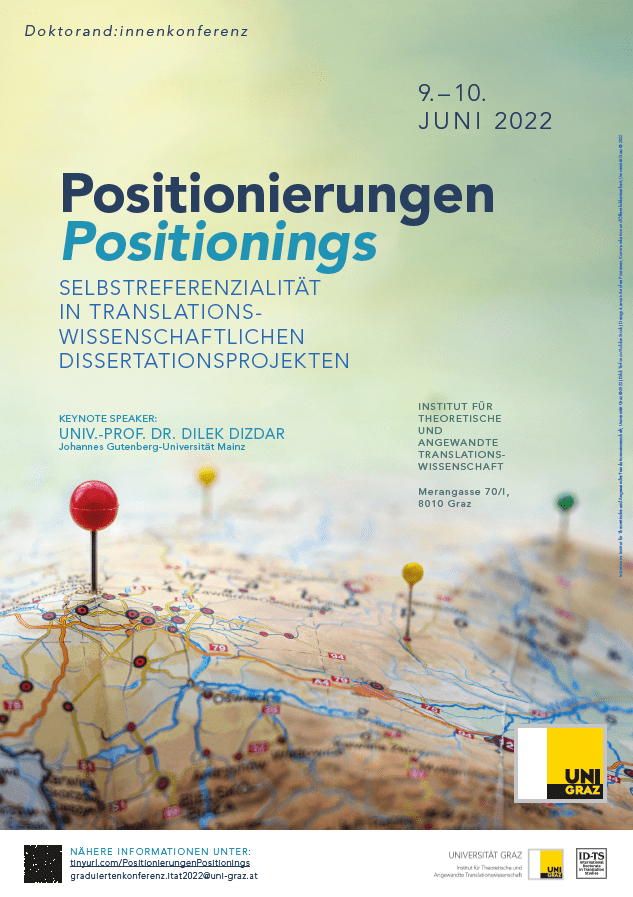
Marlene Fheodoroff, Barbara Hinterplattner, Tiana Jerkovic, Julia Kölbl, Vanessa Steinkogler und David Weiss are organising a graduate conference on the topic of self-reflexivity in PhD projects. The conference addresses aspiring translation studies scholars and will take place from 9 to 10 June 2022 at the Department of Translation Studies in Graz, Austria. More details in the below Call for Papers (in German).
die Doktorand*innen des Instituts für Theoretische und Angewandte Translationswissenschaft in Graz (Österreich) veranstalten vom 9. bis 10. Juni 2022 die vom International Doctorate in Translation Studies (ID-TS) unterstützte Graduiertenkonferenz:
Positionierungen | Positionings
Selbstreferenzialität in translationswissenschaftlichen Dissertationsprojekten
Die Konferenz richtet sich an Jungforscher*innen aus dem Bereich der Translationswissenschaft. Die Hauptkonferenzsprache ist Deutsch, es sind aber auch Beiträge auf Englisch willkommen. Bitte leiten Sie/leitet diese Ausschreibung gerne an interessierte Doktorand*innen weiter.
Up to now, the Handbook of Translation Studies (HTS) consisted of four volumes, all published between 2010 and 2013. Since research in TS continues to grow and expand, this fifth volume, with 36 new research overview articles, was added in 2021.
Our alumni Rita Menezes, Susana Valdez and Hanna Pieta are co-editing a special issue of Perspectives (Routledge) entitled “Pivot Audiovisual Translation: A burning issue for research and training”. Abstract submissions are now welcome! Deadline: 22 December 2021. More information here: http://www.indirectrans.com/ewExternalFiles/Pivot%20AVT_Special%20issue_CFP.pdf
Our affiliated research member Francis Mus (University of Antwerp) has taken the initiative to organize, together with colleagues from VUB and KU Leuven, a two-day conference on ‘Translation and World Literature, a Belgian Perspective’. This conference will take place in Antwerp on 13 and 14 December 2021, with Dutch, French and English as working languages. Below you will find the program.



 The CETRA Blog