CETRA Chair Professor 2024 Lecture Series by Lynne Bowker – Now available on YouTube

We are thrilled to announce that the recordings of the 2024 CETRA Chair Professor Lectures, delivered by Lynne Bowker (Université Laval), are now available on CETRA’s YouTube channel.

Professor Bowker delivered five lectures as part of the 2024 CETRA Research Summer School in Translation Studies, held in Antwerp from 19-30 August:

Whether you’re a scholar, practitioner, or student of translation, these lectures offer valuable perspectives on how technology is shaping the future of translation and communication – and the roles translation studies scholars can and should play in ensuring that this future is ethical, equitable and accessible.

Check out CETRA’s YouTube channel for Lynne Bowker’s lectures as well as others by past Chair Professors.

Lynne Bowker is Canada Research Chair in Translation, Technologies, and Society at the Université Laval in Quebec. Her principal research areas include translation technologies, language for special purposes, and scholarly and science communication. Prior to her professorship in Ottawa, she was a lecturer at Dublin City University in Ireland. In addition, she has held visiting positions as a guest professor or researcher at several institutions including the University of Verona, Tampere University, and the Adam Mickiewicz University.

In 2020, Professor Bowker was elected as a Fellow of the Royal Society of Canada (Academy of Arts and Humanities) in recognition of her contribution to research in translation and translation technologies. She is a member of groups such as the Canadian Association for Translation Studies, the COST Action Language in the Human-Machine Era (LITHME) and the Observatoire international sur les impacts sociétaux de l’IA et du numérique (OBVIA), as well as a certified (French-English) translator with the Association of Translators and Interpreters of Ontario. Her research has been funded by the Social Sciences and Humanities Research Council of Canada. Her recent publications include Machine Translation and Global Research (Emerald, 2019), and De-Mystifying Translation: Introducing Translation to Non-Translators (Routledge, 2023). For further information on her research activities and publications, see ORCID.

Job opportunity: Postdoctoral fellowship in news translation at the University of the Free State (South Africa)

CETRA is pleased to share the following job opportunity with the CETRA community, which comes to us from Marlie Van Rooyen and Lucile Davier:

This is a re-advertisement for a two-year postdoctoral fellowship in News Translation at the University of the Free State (UFS) in South Africa, but we now also invite applicants beyond South Africa to apply.  

The postdoc will be hosted by the UFS and participate in an international research project titled “South-North flows of information through translation in the global news agency AFP”. The principal investigators are Marlie van Rooyen (UFS) and Lucile Davier (University of Geneva), and the project is funded by the South African National Research Foundation (NRF) and the Swiss National Research Foundation (SNSF). The UFS-appointed postdoc will be based in Bloemfontein, South Africa, and supervised by Marlie van Rooyen. 

The successful applicant must be fluent in English and French, must have graduated with a PhD degree in a relevant discipline within the last five years must have a strong socio-political knowledge of Africa and not hold full-time salaried employment during the fellowship. We invite applicants with knowledge of and experience in research related to 

  • translation studies  
  • news translation
  • news/media and language
  • discourse analysis
  • pragmatics
  • sociolinguistics

Experience in qualitative research methodologies, such as ethnography, is recommended. 

Please read the full advertisement for all the requirements and the expected duties and responsibilities of the successful applicant.   

Annual salary: R300 000 

Closing date: 6 October 2024 

Commencement date: 1 January 2025

If you want more information about the project, or have any other questions, please email Marlie vanRooyen directly: vanrooyenm1@ufs.ac.za

Job opportunity: Research manager Leuven Interdisciplinary Language Institute (LILI)

CETRA is pleased to share the following job opportunity with the CETRA community, which comes to us from CETRA board member Heidi Salaets:

This job posting is available in Dutch and English.

The Leuven Interdisciplinary Language Institute (LILI) is a newly established platform for the development and support of interdisciplinary research and education around language. By bringing together researchers from KU Leuven’s three science groups, LILI aims to put language firmly and sustainably on the agenda of interdisciplinary research and public debate on major societal challenges, such as the role of language in a hyper-diverse society, the relationship between language and power, the use of large language models, etc. In addition, the institute also wants to build a strong impact network with societal actors from different domains in order to respond to questions from practitioners and set up a process of knowledge co-creation. With the establishment of LILI, KU Leuven aims to take a leading position internationally and become a strong pole of attraction for scholars and students engaged in the study of language. 

Unit website

Responsibilities

For the start-up and sustainable development of the institute, LILI is looking for a research manager, who, together with the Board of Directors and the institute’s steering committee, will set the strategic lines and help realize LILI’s mission. The research manager will be jointly responsible for the organizational and management activities of the institute, as well as for increasing its (international) visibility, organizing networking opportunities, setting up new research collaborations and support in attracting (international) research funding on behalf of LILI.

The research manager’s duties include:

  • Facilitating interdisciplinary contacts among the institute’s members and with external research partners, through the organization of lecture series, symposia, brainstorming sessions and matchmaking events, among others
  • Identifying potential funding opportunities for interdisciplinary research
  • Actively supporting project proposals from LILI members
  • Developing a training offer for (young) researchers with a distinctly interdisciplinary profile, via summer/winter schools and training modules, e.g. in the form of micro-credentials
  • Stimulating transdisciplinary cooperation with social and industrial partners, e.g. by setting up an impact network and organizing network events
  • Expanding LILI as a broad center of expertise that actively contributes to the public debate on language

Profile

Given the broad scope of the institute, involving a large number of research disciplines represented at KU Leuven (across the three science groups), and the strong focus on transdisciplinary collaboration with non-academic partners, the research manager to be appointed will preferably have relevant experience in setting up and managing interdisciplinary projects with consortia of different sizes.

Candidate research managers of LILI ideally match the following profile description:

  • You have a PhD in a field connected to LILI’s research priorities
  • You have a strong affinity with language (research)
  • You have experience with interdisciplinary research and are able to see connections between various scientific disciplines
  • You have good management skills and relevant experience with (some of) the tasks described in the above job description
  • You have excellent communication skills and are able to build an (international) network of contacts with academic and non-academic partners
  • You have a high language proficiency level for Dutch and English.

Offer

  • Appointment as a postdoctoral collaborator (scale 44 – doctor-assistant) for a period of three years, renewable once
  • Upon request, a part-time appointment (80%) is negotiable
  • You will have a varied and challenging mandate in a dynamic team of researchers from various fields. The mandate offers growth opportunities and the chance to take on greater responsibility within the team.

Interested?

For more information please contact Prof. dr. Geert Brône, tel.: +32 3 502 15 16, mail: geert.brone@kuleuven.be or Prof. dr. Karen Lahousse, tel.: +32 16 32 48 16, mail: karen.lahousse@kuleuven.be.

You can apply for this job no later than October 01, 2024 via the  online application tool 

KU Leuven strives for an inclusive, respectful and socially safe environment. We embrace diversity among individuals and groups as an asset. Open dialogue and differences in perspective are essential for an ambitious research and educational environment. In our commitment to equal opportunity, we recognize the consequences of historical inequalities. We do not accept any form of discrimination based on, but not limited to, gender identity and expression, sexual orientation, age, ethnic or national background, skin colour, religious and philosophical diversity, neurodivergence, employment disability, health, or socioeconomic status. For questions about accessibility or support offered, we are happy to assist you at this email address.

Do you have a question about the online application system? Please consult our FAQ or email us at apply@kuleuven.be

Job opportunity: Full-time PhD researcher studying paratextual representations of translators within francophone literatures (Ghent University, deadline 30 June 2024)

CETRA is pleased to share the following job opportunity with the CETRA community, which comes to us from CETRA staff member Francis Mus:

This job posting is available in Dutch, English and French.

Job description

This vacancy concerns a full-time PhD project to be conducted at the Department of Translation, Interpreting and Communication at Ghent University, Belgium. This PhD research forms part of a larger project focusing on translations and paratexts. Specifically, the successful candidate will be studying paratextual representations of translators within francophone literatures. The main research objective is to explore how translators are represented, both by themselves and by other stakeholders, including authors, editors and critics, both in peritexts (e.g. forewords and afterwords in books) and in epitexts (e.g. reviews, interviews, websites, etc.). The central research question is how translators construct, combine and/or are assigned multiple roles and identities across several types of discourse? The research will predominantly concentrate on the modern period (19th century – the present day), with French featuring as either source or target language. Within this linguistic-temporal framework, there is considerable flexibility regarding the choice of authors, translators, and texts to be analysed. Also, if you will be studying a contemporary body of works, the scope of the research may include interviews with authors, translators, publishers and other literary agents. 

Your research will be embedded in the activities of the TRACE-CLIV research group. The team is mainly based in Ghent and works in close collaboration with other research groups, both inside and outside of Ghent University (CCROC, CERES, CETRA, TRICS, CIRTI). While the research of its members covers a wide range of topics, it is usually situated on the intersection of literary studies and translation studies. 

Your job responsibilities:

  • Within a timespan of four years, you will write a PhD dissertation dealing with paratextual representations of translators in francophone literatures.
  • You will share and disseminate your ideas and interim research results through high-quality publications in scholarly journals or books, as well as through presentations at international conferences or workshops.
  • You are keen to contribute to initiatives aimed at sharing your research with a wider audience.
  • You are open to collaborating with other PhD students inside and outside Ghent University who work on parallel and complementary research projects. 

In addition to your core research duties, you will actively contribute to the educational mission of our institution by providing (limited) support for courses within the field of (literary) translation studies. In addition, you will have the opportunity to take on a mentoring role by supervising master’s theses related to the subject of your PhD. 

Job offer:

We offer the opportunity to conduct this research in an international and stimulating environment. Ghent University consistently ranks among the best 100 universities in the world. Located in the heart of Europe, Ghent is a beautiful and welcoming city offering a wealth of cultural and leisure activities.

  • You will work under the supervision of Prof. Francis Mus. Your working hours are flexible, and working from home is possible.
  • Your immediate research context is the TRACE and CLIV research groups. You can also rely on good contacts with colleagues from other research groups, both within and outside of Ghent University. Throughout your journey, you can rely on guidance from a doctoral committee.
  • Administratively, you will be part of the department’s French section, which is responsible for teaching French subjects in the department’s bachelor’s and master’s programmes.
  • Your appointment is ideally scheduled to commence on 1 September 2024, although another starting date can be arranged upon consultation.
  • Initially, the successful candidate will be offered a one-year contract, followed by an evaluation. After a positive assessment, the contract will be extended for an additional three years.
  • The fellowship amount is 100% of the net salary of an AAP member in equal family circumstances. The individual fellowship amount is determined by the Department of Personnel and Organization based on family status and seniority. A grant that meets the conditions and criteria of the regulations for doctoral fellowships is considered free of personal income tax. Click here for more information about our salary scales
  • The successful candidate will enjoy some of the benefits that Ghent University offers (such as a wide range of courses, reimbursement of your commute and eco vouchers). For a complete overview of employee benefits at Ghent University, see http://www.ugent.be/nl/vacatures/personnel benefits.htm;

Job profile

We are looking for a highly creative and motivated PhD student with the following qualifications and skills:

  • You have (or will obtain before the starting date, i.e., a few months after application) a (European) master’s degree relevant for the research project (e.g. languages, literature, translation, cultural studies) with excellent (‘honours’-level) grades.
  • You are familiar with the main methodologies and theoretical references in literary translation studies and comparative literature.
  • You have strong analytical skills to interpret the research material.
  • You are capable of working independently, possess organisational qualities and are a team player.
  • Your command of English and French – both written and spoken – is fluent. Proficiency in Dutch will be deemed an asset, particularly for practical collaboration purposes.

How to apply

Send your application by e-mail to prof. Francis Mus (francis.mus@ugent.be), with the subject ‘Application: PhD paratexts’. 

Applications (one pdf-file) should include:

  • A motivation letter in Dutch, French or English, highlighting why you believe you are a suitable candidate for this PhD project and why you want this position;
  • An academic/professional resume, including a transcript of your study results;
  • A short overview describing your earlier research or technical work (e.g., scientific papers, master thesis, report on project work, etc.). Note: This may deviate from the topic of the advertised position;
  • One sample text of your academic research until now (e.g. article, one chapter of your MA thesis, etc.);
  • At least two reference contacts. 

After a first screening, selected candidates will be invited for an interview (in person or remotely via MS Teams). 

Application deadline: June 30, 2024. 
Start of the Ph.D. research: September-October 2024

Job opportunity: Postdoctoral fellowship in translation studies and digital humanities (Université de Liège / Centre d’études Simenon)

CETRA is pleased to share the following job opportunity with the CETRA community, which comes to us from CETRA staff member Maud Gonne:

Dear colleagues,

The Centre interdisciplinaire de recherche en traduction et en interprétation of the University of Liège, in collaboration with the Centre d’études Simenon, is looking for a Postdoctoral Fellow in Translation Studies and Digital Humanities for a period of twenty months starting on 1 September 2024. Deadline to apply is 31 May 2024. Please find all details in the call for applications below.

Please feel free to circulate this job opportunity through your scientific network.

Thanks in advance,

Céline Letawe and Maud Gonne

Conference: “Writers’ Tongues: Shaping Literary Selves in Eighteenth-Century Multilingual Europe” (22 March 2024)

Although the call for papers has closed, the organisers would like to extend a warm welcome all interested colleague to attend the conference as participants. Registration is open until 12 February 2024.

The conference will approach the intellectual and authorial self-fashioning of eighteenth-century European writers from a multilingual perspective: it seeks to understand the importance of the writers’ “tongues” to their self-representation and identity/ies. It inquires into the influence of language alternations (at the level of the (para)text or the oeuvre as a whole) and, more broadly, the influence of reflections on translation and multilingualism on processes of identity construction. How did early modern writers’ cultural, social, political… identity, their values, and relations affect their language decisions? To what extent did they utilize their “tongues” to comply with, contribute to, dissent from, subvert or manipulate behavioral patterns and power structures to forge their self-representation? As Burke (2004) highlights, an individual’s language use is an ‘act of identity’, a performance depending on the situation; multilingualism and translation can therefore also be understood as tools which underscore the mutability, discordance and heterogeneity in the creation and the representation of the literary self. Conference participants are encouraged to reflect upon the theoretical concepts used in authorship, translation and literary multilingualism studies. The aim is to stimulate awareness of the importance of literary multilingualism and translation to eighteenth-century conceptions and realities of authorship.

The keynote lecture will be delivered Dr. Gillian Dow. She is an Associate Professor in English at the University of Southampton, and Head of Admissions for the Department. Dow’s current research project links her long-standing interests in eighteenth-century literature and culture, translation and reception history, and European women writers and readers. It examines British women writers and translation in the 1750-1830 period.

More information can be found here. Registration is open till the 12th of February.

Venue: The Faculty Club, Groot Begijnhof 14, 3000 Leuven

Call for conference papers: ‘Book translation in multilingual states (1945-2024)’ (Brussels, deadline for abstracts: 1 April 2024)

CETRA is pleased to help spread the word about an upcoming international conference to be held in Brussels from 28-29 November 2024 on the topic of ‘Book translation in multilingual states (1945-2024)‘, organised jointly by KU Leuven, UCLouvain and the Royal Library of Belgium. The deadline for the submission of abstracts is 1 April 2024. A PDF of the full call is reproduced below.

Call for participants: ‘Linguistic Landscapes: Using Signs and Symbols to Translate Cities’

CETRA is pleased to spread the word about an upcoming, interdisciplinary summer school organized by colleagues at Venice International University, University of Exeter and KU Leuven on the topic of ‘Linguistic Landscapes: Using Signs and Symbols to Translate Cities‘. The summer school will take place on 24-28 June, 2024, in Venice, Italy. Applications are due by 5 March 2024 and can be submitted via the VIU website.

What is the aim of the school?

The aim of the school is to study the multimodal domain of images, sounds, drawings, movements, visuals, graffiti, tattoos, colours, smells as well as people. It will focus on language and linguistic signs and how they translate cities, in a broad sense. The school will also give you the opportunity to carry out research in Venice and explore the cultural profile of our cities.

Who is it for?

Applications are welcome from current final-year undergraduates (finalists, BA3), MA and MPhil/PhD students in Linguistics, Sociology, Classical Studies, (Business) Communication Studies, History, Cultural Studies, Political Studies, Translation Studies, or any other related discipline.

More information

For further information, please write to: summerschools@univiu.org or visit the summer school website: https://www.univiu.org/study/summer-schools/linguistic-landscapes

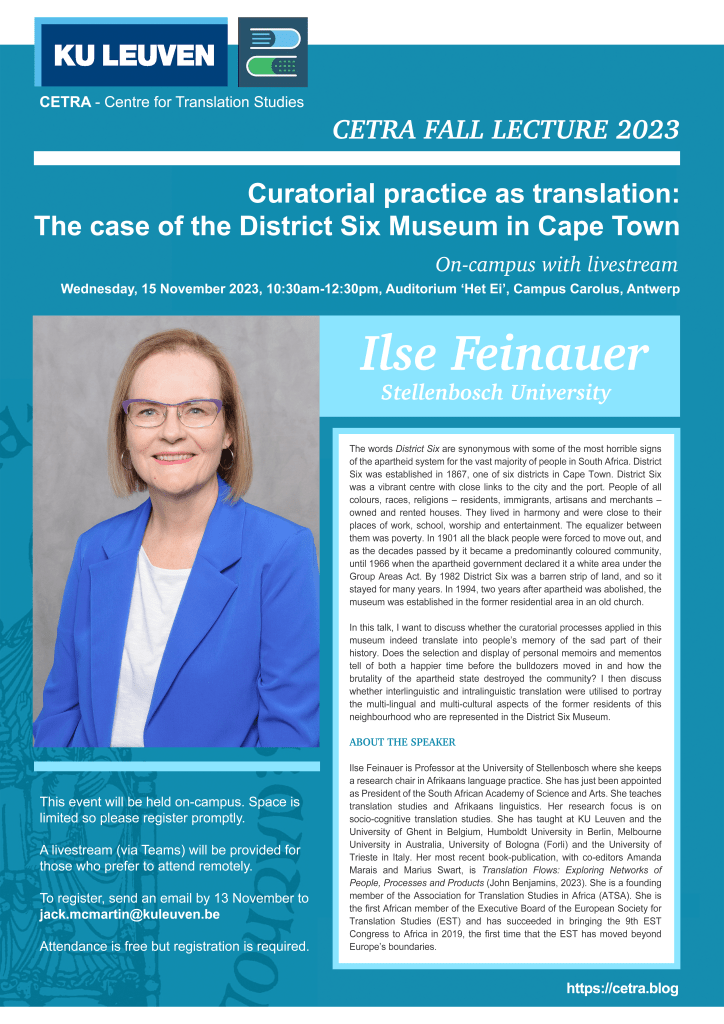
Invitation: CETRA Fall Lecture 2023 by Ilse Feinauer, “Curational practice as translation: The case of the District Six Museum in Cape Town”, 15 November 2023, 10:30am (on-campus and online)

CETRA is pleased to welcome Professor Ilse Feinauer (University of Stellenbosch) in Antwerp to deliver the CETRA Fall Lecture 2023. Her lecture will take place on Wednesday, 15 November 2023 from 10:30am to 12:30pm in Auditorium ‘Het Ei‘ on the Carolus Campus (Hendrik Conscienceplein 8, 2000 Antwerp). A livestream (via Teams) will also be provided for those who prefer to attend remotely. To register, send an email by 13 November to jack.mcmartin@kuleuven.be.

Curatorial practice as translation: The case of the District Six Museum in Cape Town

Abstract

The words District Six are synonymous with some of the most horrible signs of the apartheid system for the vast majority of people in South Africa. District Six was established in 1867, one of six districts in Cape Town. District Six was a vibrant centre with close links to the city and the port. People of all colours, races, religions – residents, immigrants, artisans and merchants – owned and rented houses. They lived in harmony and were close to their places of work, school, worship and entertainment. The equalizer between them was poverty. In 1901 all the black people were forced to move out, and as the decades passed by it became a predominantly coloured community, until 1966 when the apartheid government declared it a white area under the Group Areas Act. By 1982 District Six was a barren strip of land, and so it stayed for many years. In 1994, two years after apartheid was abolished, the museum was established in the former residential area in an old church.

In this talk, I want to discuss whether the curatorial processes applied in this museum indeed translate into people’s memory of the sad part of their history. Does the selection and display of personal memoirs and mementos tell of both a happier time before the bulldozers moved in and how the brutality of the apartheid state destroyed the community? I then discuss whether interlinguistic and intralinguistic translation were utilised to portray the multi-lingual and multi-cultural aspects of the former residents of this neighbourhood who are represented in the District Six Museum.

About the speaker

Ilse Feinauer is Professor at the University of Stellenbosch where she keeps a research chair in Afrikaans language practice. She has just been appointed as President of the South African Academy of Science and Arts. She teaches translation studies and Afrikaans linguistics. Her research focus is on socio-cognitive translation studies. She has taught at KU Leuven and the University of Ghent in Belgium, Humboldt University in Berlin, Melbourne University in Australia, University of Bologna (Forli) and the University of Trieste in Italy. Her most recent book-publication, with co-editors Amanda Marais and Marius Swart, is Translation Flows: Exploring Networks of People, Processes and Products (John Benjamins, 2023). She is a founding member of the Association for Translation Studies in Africa (ATSA). She is the first African member of the Executive Board of the European Society for Translation Studies (EST) and has succeeded in bringing the 9th EST Congress to Africa in 2019, the first time that the EST has moved beyond Europe’s boundaries.

Call for Papers: Translation and Labour (special issue of Target, abstract deadline 15 January 2024)

To date, labour has, at best, played a marginal role in Translation Studies. While ‘work’ is perhaps more readily associated with translation, in professional discourses at least, translation as ‘labour’, i.e. as an activity structurally embedded in capitalist chains of surplus-value production (Zwischenberger and Alfer 2022), features far less prominently in current debates. What is more, neither labour nor work, as concepts in their own right, have so far been systematically applied in Translation Studies.

Foregrounding labour as a fundamental dimension of translation (and, for that matter, interpreting) should allow both researchers and practitioners to investigate translation and interpreting more closely from a socioeconomic perspective. This should, in turn, help critique the ubiquitous but increasingly stale ‘professionalisation’ discourses that, while aiming to raise the socio-economic status of translators and interpreters, too often create idealised narratives of translation and interpreting that foreground the processes of work while masking the labour involved in producing outputs whose value is, quietly or overtly, appropriated by those with a stake in the means of their production.

This special issue will be devoted to explorations of translational labour as prompted by translaboration’s (Alfer 2017) hallmark blending of ‘translation’ and ‘collaboration’. It posits that the concept of labour, as distinct from work (Arendt 1958/1998; Narotzky 2018), warrants more sustained engagement on the part of both Translation Studies and the translation profession. Indeed, the relationship between work and labour itself bears closer investigation from a Translation Studies perspective, not least because of the often deliberately obfuscating confluence of the two notions both in the professional sphere and in debates about the demarcation lines between professional and non-professional translation.

We invite contributors to probe the (im-)material and discursive conditions of translational labour, interrogate the spaces in which the labour of translation and interpreting is performed, and explore the various types of labour that apply to translation and interpreting. While digital labour (Fuchs 2020), playbor (Kücklich 2005), fan labour (De Kosnik 2012), affective labour (Hardt 1999; Koskinen 2020), emotional labour (Hochschild 1983), or (im)material labour (Negri & Hardt 2004) may present themselves as particularly topical sites for such exploration, many of these categories are not clear-cut, overlap, or reveal blurred boundaries. Affective labour, for example, reaches, once applied to translation and interpreting, far beyond Negri and Hardt’s binary of care, kin work, and maternal labour on the one hand, and the immaterial labour involved in producing intellectual or linguistic products such as ideas, symbols, codes, texts, images, etc. on the other. While immaterial labour was originally conceived as arising from the communications of everyday life, it has increasingly become the domain of a new cognitariat and is, as such, deeply embedded in virtual, digital economies where, given the rapid advances of GenAI, translational labour and the data it generates increasingly compete with one another as sites of value generation. Affective labour, meanwhile, can serve as a useful category to interrogate translators’ and interpreters’ (self-) perception (Koskinen 2020) and entertains close ties with the emotional labour entailed in their professional personae’s myriad acts of self-regulation (Hochschild 1983; Ayan 2020). These, in turn, can be read as internalised responses to the power asymmetries rooted in the positivist and neoliberal orders of discourse (Baumgarten 2017) that govern the translation industry, academia, and perhaps Translation Studies in particular. Finally, extending considerations of labour to current debates about the translation concept as such not only shines a spotlight on the surplus-value inherent in translation as the commodifiable expansion of a source text, but also uncovers the translation concept itself as the site of an unarticulated and unresolved tension between two competing and converging cultural narratives that pivot on conceptions of translational value as, on the one hand, inextricably bound to and, on the other, posited firmly “outside of a profit-motivated relationship” (Fayard 2021, 216).

This special issue is based on the successful two-day Translab 4: Translation and Labour symposium jointly organised by the University of Westminster and the Centre for Translation Studies at the University of Vienna, and held in London in July 2023. It will explore labour in relation to translation and interpreting from a range of philosophical, sociological, socioeconomic, and professional as well as academic perspectives. We welcome proposals for conceptual papers as well as case studies and empirical research contributions that address the labour and work of translation and interpreting in both theory and practice, and in, among others, the following contexts:

  • translation and interpreting as labour and/or work
  • flows of translational capital and value accumulation in professional and nonprofessional
    contexts
  • translation and interpreting as digital labour
  • translation and interpreting as (im)material labour
  • translation and interpreting as fan labour
  • translation and interpreting as affective labour and/or emotional labour
  • narratives of translational labour/work and their effect(s) on the interests, status, and working conditions of translators and other stakeholders

To propose a paper, please send your abstract (700-800 words excluding references) to both editors of this Special Issue:
• Alexa Alfer (A.Alfer01@westminster.ac.uk)
• Cornelia Zwischenberger (cornelia.zwischenberger@univie.ac.at)

Deadline for proposals: 15 January 2024
All authors will be notified of the outcome of their submissions by 15 March 2024. All accepted contributors will receive further instructions and information with their notification of acceptance. All accepted contributions will be subject to double-blind peer-review.