Conference: “Writers’ Tongues: Shaping Literary Selves in Eighteenth-Century Multilingual Europe” (22 March 2024)

Although the call for papers has closed, the organisers would like to extend a warm welcome all interested colleague to attend the conference as participants. Registration is open until 12 February 2024.

The conference will approach the intellectual and authorial self-fashioning of eighteenth-century European writers from a multilingual perspective: it seeks to understand the importance of the writers’ “tongues” to their self-representation and identity/ies. It inquires into the influence of language alternations (at the level of the (para)text or the oeuvre as a whole) and, more broadly, the influence of reflections on translation and multilingualism on processes of identity construction. How did early modern writers’ cultural, social, political… identity, their values, and relations affect their language decisions? To what extent did they utilize their “tongues” to comply with, contribute to, dissent from, subvert or manipulate behavioral patterns and power structures to forge their self-representation? As Burke (2004) highlights, an individual’s language use is an ‘act of identity’, a performance depending on the situation; multilingualism and translation can therefore also be understood as tools which underscore the mutability, discordance and heterogeneity in the creation and the representation of the literary self. Conference participants are encouraged to reflect upon the theoretical concepts used in authorship, translation and literary multilingualism studies. The aim is to stimulate awareness of the importance of literary multilingualism and translation to eighteenth-century conceptions and realities of authorship.

The keynote lecture will be delivered Dr. Gillian Dow. She is an Associate Professor in English at the University of Southampton, and Head of Admissions for the Department. Dow’s current research project links her long-standing interests in eighteenth-century literature and culture, translation and reception history, and European women writers and readers. It examines British women writers and translation in the 1750-1830 period.

More information can be found here. Registration is open till the 12th of February.

Venue: The Faculty Club, Groot Begijnhof 14, 3000 Leuven

Call for conference papers: ‘Book translation in multilingual states (1945-2024)’ (Brussels, deadline for abstracts: 1 April 2024)

CETRA is pleased to help spread the word about an upcoming international conference to be held in Brussels from 28-29 November 2024 on the topic of ‘Book translation in multilingual states (1945-2024)‘, organised jointly by KU Leuven, UCLouvain and the Royal Library of Belgium. The deadline for the submission of abstracts is 1 April 2024. A PDF of the full call is reproduced below.

Call for participants: ‘Linguistic Landscapes: Using Signs and Symbols to Translate Cities’

CETRA is pleased to spread the word about an upcoming, interdisciplinary summer school organized by colleagues at Venice International University, University of Exeter and KU Leuven on the topic of ‘Linguistic Landscapes: Using Signs and Symbols to Translate Cities‘. The summer school will take place on 24-28 June, 2024, in Venice, Italy. Applications are due by 5 March 2024 and can be submitted via the VIU website.

What is the aim of the school?

The aim of the school is to study the multimodal domain of images, sounds, drawings, movements, visuals, graffiti, tattoos, colours, smells as well as people. It will focus on language and linguistic signs and how they translate cities, in a broad sense. The school will also give you the opportunity to carry out research in Venice and explore the cultural profile of our cities.

Who is it for?

Applications are welcome from current final-year undergraduates (finalists, BA3), MA and MPhil/PhD students in Linguistics, Sociology, Classical Studies, (Business) Communication Studies, History, Cultural Studies, Political Studies, Translation Studies, or any other related discipline.

More information

For further information, please write to: summerschools@univiu.org or visit the summer school website: https://www.univiu.org/study/summer-schools/linguistic-landscapes

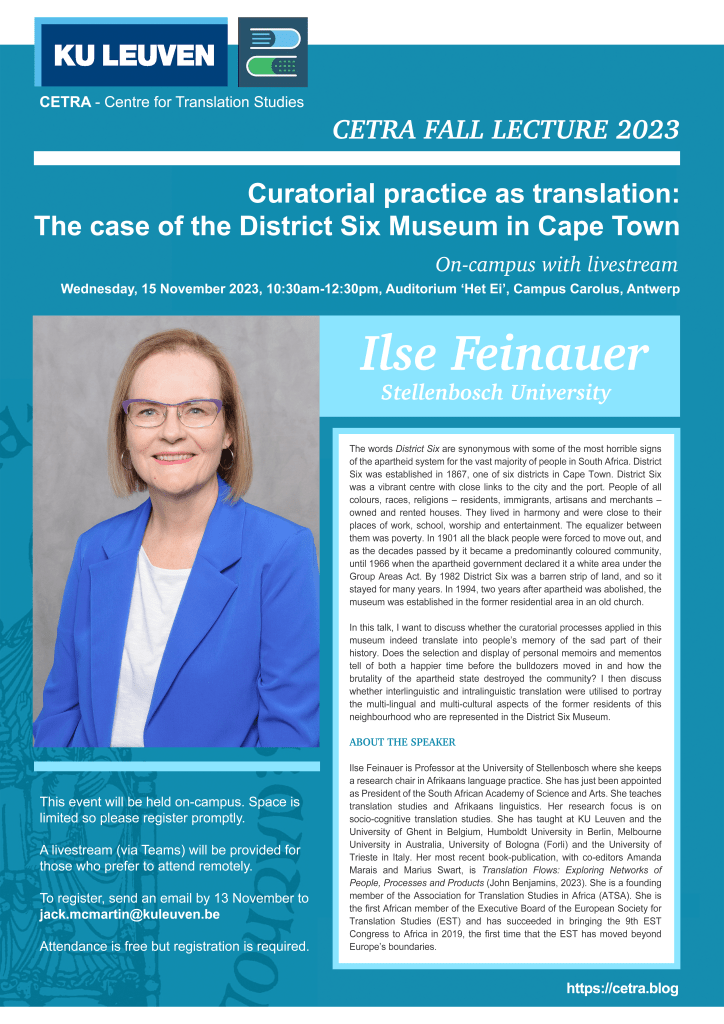
Invitation: CETRA Fall Lecture 2023 by Ilse Feinauer, “Curational practice as translation: The case of the District Six Museum in Cape Town”, 15 November 2023, 10:30am (on-campus and online)

CETRA is pleased to welcome Professor Ilse Feinauer (University of Stellenbosch) in Antwerp to deliver the CETRA Fall Lecture 2023. Her lecture will take place on Wednesday, 15 November 2023 from 10:30am to 12:30pm in Auditorium ‘Het Ei‘ on the Carolus Campus (Hendrik Conscienceplein 8, 2000 Antwerp). A livestream (via Teams) will also be provided for those who prefer to attend remotely. To register, send an email by 13 November to jack.mcmartin@kuleuven.be.

Curatorial practice as translation: The case of the District Six Museum in Cape Town

Abstract

The words District Six are synonymous with some of the most horrible signs of the apartheid system for the vast majority of people in South Africa. District Six was established in 1867, one of six districts in Cape Town. District Six was a vibrant centre with close links to the city and the port. People of all colours, races, religions – residents, immigrants, artisans and merchants – owned and rented houses. They lived in harmony and were close to their places of work, school, worship and entertainment. The equalizer between them was poverty. In 1901 all the black people were forced to move out, and as the decades passed by it became a predominantly coloured community, until 1966 when the apartheid government declared it a white area under the Group Areas Act. By 1982 District Six was a barren strip of land, and so it stayed for many years. In 1994, two years after apartheid was abolished, the museum was established in the former residential area in an old church.

In this talk, I want to discuss whether the curatorial processes applied in this museum indeed translate into people’s memory of the sad part of their history. Does the selection and display of personal memoirs and mementos tell of both a happier time before the bulldozers moved in and how the brutality of the apartheid state destroyed the community? I then discuss whether interlinguistic and intralinguistic translation were utilised to portray the multi-lingual and multi-cultural aspects of the former residents of this neighbourhood who are represented in the District Six Museum.

About the speaker

Ilse Feinauer is Professor at the University of Stellenbosch where she keeps a research chair in Afrikaans language practice. She has just been appointed as President of the South African Academy of Science and Arts. She teaches translation studies and Afrikaans linguistics. Her research focus is on socio-cognitive translation studies. She has taught at KU Leuven and the University of Ghent in Belgium, Humboldt University in Berlin, Melbourne University in Australia, University of Bologna (Forli) and the University of Trieste in Italy. Her most recent book-publication, with co-editors Amanda Marais and Marius Swart, is Translation Flows: Exploring Networks of People, Processes and Products (John Benjamins, 2023). She is a founding member of the Association for Translation Studies in Africa (ATSA). She is the first African member of the Executive Board of the European Society for Translation Studies (EST) and has succeeded in bringing the 9th EST Congress to Africa in 2019, the first time that the EST has moved beyond Europe’s boundaries.

Call for Papers: Translation and Labour (special issue of Target, abstract deadline 15 January 2024)

To date, labour has, at best, played a marginal role in Translation Studies. While ‘work’ is perhaps more readily associated with translation, in professional discourses at least, translation as ‘labour’, i.e. as an activity structurally embedded in capitalist chains of surplus-value production (Zwischenberger and Alfer 2022), features far less prominently in current debates. What is more, neither labour nor work, as concepts in their own right, have so far been systematically applied in Translation Studies.

Foregrounding labour as a fundamental dimension of translation (and, for that matter, interpreting) should allow both researchers and practitioners to investigate translation and interpreting more closely from a socioeconomic perspective. This should, in turn, help critique the ubiquitous but increasingly stale ‘professionalisation’ discourses that, while aiming to raise the socio-economic status of translators and interpreters, too often create idealised narratives of translation and interpreting that foreground the processes of work while masking the labour involved in producing outputs whose value is, quietly or overtly, appropriated by those with a stake in the means of their production.

This special issue will be devoted to explorations of translational labour as prompted by translaboration’s (Alfer 2017) hallmark blending of ‘translation’ and ‘collaboration’. It posits that the concept of labour, as distinct from work (Arendt 1958/1998; Narotzky 2018), warrants more sustained engagement on the part of both Translation Studies and the translation profession. Indeed, the relationship between work and labour itself bears closer investigation from a Translation Studies perspective, not least because of the often deliberately obfuscating confluence of the two notions both in the professional sphere and in debates about the demarcation lines between professional and non-professional translation.

We invite contributors to probe the (im-)material and discursive conditions of translational labour, interrogate the spaces in which the labour of translation and interpreting is performed, and explore the various types of labour that apply to translation and interpreting. While digital labour (Fuchs 2020), playbor (Kücklich 2005), fan labour (De Kosnik 2012), affective labour (Hardt 1999; Koskinen 2020), emotional labour (Hochschild 1983), or (im)material labour (Negri & Hardt 2004) may present themselves as particularly topical sites for such exploration, many of these categories are not clear-cut, overlap, or reveal blurred boundaries. Affective labour, for example, reaches, once applied to translation and interpreting, far beyond Negri and Hardt’s binary of care, kin work, and maternal labour on the one hand, and the immaterial labour involved in producing intellectual or linguistic products such as ideas, symbols, codes, texts, images, etc. on the other. While immaterial labour was originally conceived as arising from the communications of everyday life, it has increasingly become the domain of a new cognitariat and is, as such, deeply embedded in virtual, digital economies where, given the rapid advances of GenAI, translational labour and the data it generates increasingly compete with one another as sites of value generation. Affective labour, meanwhile, can serve as a useful category to interrogate translators’ and interpreters’ (self-) perception (Koskinen 2020) and entertains close ties with the emotional labour entailed in their professional personae’s myriad acts of self-regulation (Hochschild 1983; Ayan 2020). These, in turn, can be read as internalised responses to the power asymmetries rooted in the positivist and neoliberal orders of discourse (Baumgarten 2017) that govern the translation industry, academia, and perhaps Translation Studies in particular. Finally, extending considerations of labour to current debates about the translation concept as such not only shines a spotlight on the surplus-value inherent in translation as the commodifiable expansion of a source text, but also uncovers the translation concept itself as the site of an unarticulated and unresolved tension between two competing and converging cultural narratives that pivot on conceptions of translational value as, on the one hand, inextricably bound to and, on the other, posited firmly “outside of a profit-motivated relationship” (Fayard 2021, 216).

This special issue is based on the successful two-day Translab 4: Translation and Labour symposium jointly organised by the University of Westminster and the Centre for Translation Studies at the University of Vienna, and held in London in July 2023. It will explore labour in relation to translation and interpreting from a range of philosophical, sociological, socioeconomic, and professional as well as academic perspectives. We welcome proposals for conceptual papers as well as case studies and empirical research contributions that address the labour and work of translation and interpreting in both theory and practice, and in, among others, the following contexts:

  • translation and interpreting as labour and/or work
  • flows of translational capital and value accumulation in professional and nonprofessional
    contexts
  • translation and interpreting as digital labour
  • translation and interpreting as (im)material labour
  • translation and interpreting as fan labour
  • translation and interpreting as affective labour and/or emotional labour
  • narratives of translational labour/work and their effect(s) on the interests, status, and working conditions of translators and other stakeholders

To propose a paper, please send your abstract (700-800 words excluding references) to both editors of this Special Issue:
• Alexa Alfer (A.Alfer01@westminster.ac.uk)
• Cornelia Zwischenberger (cornelia.zwischenberger@univie.ac.at)

Deadline for proposals: 15 January 2024
All authors will be notified of the outcome of their submissions by 15 March 2024. All accepted contributors will receive further instructions and information with their notification of acceptance. All accepted contributions will be subject to double-blind peer-review.

Call for Papers: Authorship in a Global and Transnational Context (KU Leuven, 30-31 May 2024)

Since the consolidation of world literature as a field of research in the 1990s, the study of literature beyond national frameworks has almost become commonplace. While the focus of this discipline has been on the transformations and shifting positions of literary texts as they circulate across borders, the impact of this transnational perspective on notions of authorship remains understudied. In What Is World Literature? (2003), David Damrosch elaborates on the polemics surrounding Rigoberta Menchú’s memoir Me llamo Rigoberta Menchú (1985), co-authored with Elizabeth Burgos, warning about the potential pitfalls of introducing works into new contexts, but he does not fully theorize the importance of transnational authorship for the making and circulation of world literature (an importance that has only grown since he published his book). Historically, research on exile literature has helped highlight the relationship between memory, trauma and unbelonging as well as the challenges of giving voice to someone else’s story, particularly in the genre of testimonies. Rooted in specific historical moments (Holocaust, Latin American revolutions), this framework proves too limiting to analyze the diversity of aesthetic practices, subjective experiences and cultural contexts that characterizes today’s transnational literary production. In parallel with the transnational shift brought about by world literature, migrant and refugee literature, broadly understood as all writing that is shaped by the experience of (forced) migration, have become an object of considerable scholarly attention in literary studies, as visible, for instance, in Mads Rosendahl Thomsen’s comparative discussion of modernist and contemporary migrant authors in relation to cosmopolitan culture in Mapping World Literature (2008) or in the important role that the aesthetics of displacement play in the interdisciplinary book Refugee Imaginaries (2019). Despite these crucial developments, investigations on the effects of the increasing global mobility on literature tend to favor biographical readings, accentuating the multiple ethnic affiliations of individual authors, their complicated relation to the nation-state and the sense of linguistic and cultural division that inflects their works. This return to the author in rather conventional ways has not led to significant theoretical innovations that foreground the subversive potential of transnational texts in redefining who counts as an author.

This symposium aims to break new ground in literary studies by shifting the discussion to notions of authorship that go beyond national and individual singularity. Recent contributions, such as studies on digital writing and the World Authorship volume (2020), edited by Tobias Boes, Rebecca Braun and Emily Spiers, move away from the Romantic image of the author as a solitary figure and foreground the broad network of agents involved in the making of a text, including translators, institutions, editors, new media or writing collectives. This symposium takes the debate one step further by emphasizing the collaborative and multilingual nature of transnational authorship in contexts of migration. The concept of transnational authorship refers to literary texts co-written by authors with different linguistic and cultural backgrounds as well as single-authored texts that result from collective networks of solidarity across borders and collaborative dialogues with migrants. Even though transnational authorship arises from a sense of cosmopolitan solidarity with distant others, it is deeply embedded in the political and social hierarchies that shape national migration policies and the global order. Therefore, the symposium will take into account possible linguistic and cultural asymmetries and multiple scales of power relations (gender, age, geographical location, legal status, etc.) that impinge on the production of transnational texts.

The symposium is part of the ERC Starting Grant project “COLLAB: Making Migrant Voices Heard through Literature: How Collaboration Is Changing the Cultural Field”, which looks at a wide array of collaborative practices that create spaces for literary participation of migrants. While the project focuses specifically on contemporary literary production in Europe, the symposium welcomes case studies from various historical periods, languages and geographies, particularly from the Global South.

Possible topics
To further develop the notion of transnational authorship from varied disciplinary and linguistic angles, the symposium invites papers that include, but are not limited to, the following topics:

  • Case studies of transnational authorship and collaboration located in Global South or involving non-European languages
  • Networks of solidarity between writers across borders, especially in contexts of migration
  • Examples of retelling and literary remediation in transnational and multilingual contexts
  • The role of digital media in facilitating transnational collaborations between authors
  • Self-critical reflections by writers, artists and activists involved in transnational collaborative practices
  • Translation and multilingualism in transnational authorship
  • Power relations in transnational authorship
  • Circulation and sociological approaches to transnational authorship
  • Historical approaches to transnational authorship, especially during the interwar period and in contexts of migration

Submission guidelines
We welcome proposals in English for 20-minute papers, followed by discussion and collective debate. Please send abstracts of no more than 300 words and a bionote (150 words) to collab@kuleuven.be by 15 December 2023. Notification of acceptance will be sent by 15 January 2024.

Keynote speaker
Leila Essa, Institute for Cultural Inquiry, Utrecht University

Organizing committee
Núria Codina (Principal Investigator) and the COLLAB team.

More information on the COLLAB project can be found here.

The COLLAB project has received funding from the European Research Council (ERC) under the European Union’s Horizon Europe research and innovation programme (grant agreement n° 101076847). Views and opinions expressed in this announcement are those of the author(s) only and do not necessarily reflect those of the European Union or the European Research Council. Neither the European Union nor the granting authority can be held responsible for them.

The 34th CETRA Summer School has concluded!

The 34th CETRA Research Summer School in Translation Studies has concluded, with a celebratory closing session honouring the contributions of its 2023 Chair Professor, Hanna Risku, and the members of the CETRA Class of 2023. Thank you to all who took part!

Recordings of the Chair Professor’s lectures can be found here:

  • Socio-cognitive translation studies and the situatedness of translation | Monday, 28 August, 10:30 am (Brussels time) | Click here for the closed-captioned recording
  • Distributed translatorship: A comparison of individualized, situated and extended agency | Tuesday, 29 August, 10:30 am (Brussels time) | Click here for the closed-captioned recording
  • Field research in translation studies: The challenging journey of doing research at the workplace | Thursday, 31 August, 9:00 am (Brussels time) | Click here for the closed-captioned recording.
  • Rethinking translation expertise: Lived practice and social construction | Monday, 4 September, 10:15 am (Brussels time) | Click here for the recording. (Note that the closed-captions for this recording are in the process of being post-edited and may contain errors.)
  • Practitioner and employer views on translation expertise: Insights from ongoing empirical research | Wednesday, 6 September, 9:00 am (Brussels time) | Click here for the recording. (Note that the closed-captions for this recording are in the process of being post-edited and may contain errors.)

Call for papers: ‘Affect in Translation’ (edited volume)

Translation Studies scholars have shown a growing interest in the role affect and emotions play in the translation process. Research in this vein has explored links between affect and translation in various domains, including literature, business, governance, and translator/interpreter training (Kußmaul 1991, Jääskeläinen 1996, Ruokonen & Koskinen 2017, Shadman 2020). Various methodologies have been brought to bear, ranging from qualitative methods such as TAP (Jääskeläinen 1996), interviews (Risku & Meinx 2021), and narrative accounts (Ruokonen & Koskinen 2017). These tools have proven useful in identifying and investigating the parameters that affect translators’ and interpreters’ performance and how emotional intelligence informs the translation process (Shadman 2020, Hubscher-Davidson 2021, Rojo 2017). Despite the great interdisciplinary potential of interfacing insights from psychology and cognitive scienceswith Translation Studies, researchers have thus far primarily focused on emotions from a cognitive perspective only. One notable exception is Kaisa Koskinen’s Translation and Affect: Essays on Sticky Affects and Translational Affective (2020), which invites scholars to rethink the role of “affect” in translation by including cultural and sociological approaches that highlight the relevance of affect theory to Translation Studies. Building on Koskinen’s pioneering work, this volume seeks to advance our understanding of affect’s interplay in translational phenomena by contributing new methodological and conceptual insights and exploring new empirical domains.

One indication of the need for conceptual elaboration is the profusion of different definitions of affect. Koskinen understands affect as a “body-mind complex that directs a person towards a desired state of affairs through a process of change” (13). Under this framework, affect is “bodily grounded. We can only be affected by what our sensory systems register, and this is constrained by both our bodily capacities and our material location” (179). Translation can thus be viewed as an activity in which affect plays an important role. Following Koskinen’s approach, we are interested in exploring the links between the individual and the social by highlighting emotional and physiological aspects involved in translation. Our volume hopes to build on this conceptualisation of affect that privileges human experience in times when technological advances often take centre stage, without forgetting that translation technologies also affect the translator and other translation actors both cognitively and socially (Pym, 2011). For instance, the use of increasingly high-performance digital tools and machine translation transforms the translator’s tasks and raises new questions regarding dialogue (Pym, 2011), agency, creativity, or individual voices, all of which arguably fall into the realm of affect (Koskinen, 2020: 155). Taking this into consideration, the goal of this volume is twofold. Firstly, it pursues a “sociocultural theorization of the roles of affect in translatorial activities” (6). Secondly, it aims to connect affect to the subfield of translator studies, which covers “sociology, culture and cognition” (Chesterman 2009: 13), in order to articulate the need for research focused on the agents and actors involved in translation rather than solely on the translated text. Agent- and process-oriented research allows for an in-depth examination of the translator’s agency and the influence of culture and society on their choices. Similarly, widely discussed questions such as translator training, ethics, and the translator’s (in)visibility need revisiting in light of affect theory.

Since translation is a cultural rather than a solely linguistic act, and given that affect is embedded in culture and is context-dependent, the intersection of affect and translation is best studied not only from an interdisciplinary point of view, but also through an exploration of novel and combined methods that pertain to the realm of ethnographic, literary-artistic, philosophical, cultural studies. In line with the contributions of Goldfajn (2020) and Koskinen hailing from cultural studies, this volume seeks to highlight the centrality of affect and emotions in translation and to offer new avenues for exploring future directions in the discipline. We welcome diverse perspectives, methodologies, and case studies that explore the cultural and social nature of both affect and translation, such as – but not exclusive to – cognitive, gendered, embodied, postcolonial, psychological and historical approaches that address one or more of the following questions: 

– What is the role of affect on and between the different agents/actors in the translation field? 

– How does translation shape affect in specific contexts or in relation to certain social phenomena? This question could be linked to climate change narratives, heritage, politics, journalism, current events, science, literature, national/cultural identity, censorship, etc. 

– How are translators and interpreters affected by technology (e.g., CAT tools, translation memories, AI)? What could be the possible impacts on the future development of the profession? 

– To what extent do sociocultural and economic factors such as gender, education, linguistic policies, and cultural politics influence affect, particularly in translation situations? What can this teach us about translators and the translation process? 

– How can a more explicit focus on affect advance the state of the art in other areas of interest in TS, such as self-translation, retranslation, and untranslatability? 

Abstract submissions

Please send your abstract (500-750 words) and bio (150 words) to affectintranslation@gmail.com by 15 November 2023.

Important dates

15 November 2023 – Abstract submission deadline (500-750 words) and author’s bio (150 words)

15 February 2024 – Notification of acceptance

15 September 2024 – Chapter submission deadline (6000-8000 words, including notes and references)

Summer 2025 – Estimated publication

Selected bibliography

Ahmed, Sara (2014). The Cultural Politics of Emotion. NED-New edition, 2, Edinburgh University Press. JSTOR,http://www.jstor.org/stable/10.3366/j.ctt1g09x4q

Anderson, Jean (2005). The Double Agent: Aspects of Literary Translator Affect as Revealed in Fictional Work by Translators. Linguistica Antverpiensia, vol. 4, pp. 171-182, https://doi.org/10.52034/lanstts.v4i.134

Bennett, Andrew & Nicholas Royle (2016). Feelings. An Introduction to Literature, Criticism and Theory, Taylor & Francis Group, pp. 88–99. ProQuest Ebook Central, http://ebookcentral.proquest.com/lib/ed/detail.action?docID=4429796

Brinkema, Eugenie (2014). The Forms of Affect. Duke UP.

Chesterman, Andrew (2009). The Name and Nature of Translator Studies. Journal of Language and Communication Studies, pp. 13-22. https://tidsskrift.dk/her/article/download/96844/145601/.

Goldfajn, Tal (2022). The Translator and the Pea. In Susan Petrilli and Meng Ji (eds.) Intersemiotic Perspectives on Emotions, London/Routledge, pp. 45–62, https://doi.org/10.4324/9781003056652-4

Clough, Patricia Ticineto & Halley, Jean O’Malley (eds.) (2007). The Affective Turn: Theorizing the Social. Durham: Duke UP.

Gregg, Melissa & Gregory J. Seigworth (ed.) (2010). The Affect Theory Reader. Duke University Press. 

Gunew, Sneja (2016). Excess of Affect: In Translation. Hecate, vol. 42, no. 2, pp. 7-23. 

Houen, Alex (2020). Affect and Literature. Cambridge UP.

Hubscher-Davidson, Séverine (2021). Emotions and Translation. Handbook of Translation Studies Online, John Benjamins Publishing Company, https://benjamins.com/online/hts/articles/emo1. Accessed 21 Oct. 2022. 

Hubscher-Davidson, Séverine & Caroline Lehr (eds.) (2023). The Psychology of Translation. An Interdiscplinary Approach, Routledge.

—. (2016) Trait Emotional Intelligence and Translation: A Study of Professional Translators. Target. International Journal of Translation Studies, vol. 28, no. 1, pp. 132-57. http://www.jbe-platform.com,https://doi.org/10.1075/target.28.1.06hub

—. (2017) Translation and Emotion – A Psychological Perspective. Routledge. oro.open.ac.uk,https://www.routledge.com/Translation-and-Emotion-A-Psychological-Perspective/Hubscher-Davidson/p/book/9781138855335

Jääskeläinen, Riitta (1996). Hard work will bear beautiful fruit: A comparison of two think-aloud protocol studies. Meta 41(1), pp. 60–74.

Koskinen, Kaisa & Outi Paloposki (2015). Anxieties of Influence. The Voice of the First Translator in Retranslation. Target 27, pp. 25-39. 

Koskinen, Kaisa (2020). Translation and Affect: Essays on Sticky Affects and Translational Affective. John Benjamins Publishing Company.

Kußmaul, Paul (1991). Creativity in the translation process: Empirical approaches. In Kitty M. Van Leuven-Zwart & Ton Naaijkens (eds.), Translation studies: The state of the art. Proceedings of the first James S. Holmes symposium on translation studies, Amsterdam: Rodopi, pp. 91-101

Lehr, Caroline (2020). Translation, emotion and cognition. In Fabio Alves and Arnt Jakobsen (eds.), The Routledge Handbook of Translation and Cognition, Abington/Oxon: Routledge. https://doi.org/10.4324/9781315178127 

Martin, James & Peter White (2005). The Language of Evaluation: Appraisal in English. New York: Palgrave Macmillan. https://doi.org/10.1057/9780230511910.

Pym, Anthony (2011). What technology does to translating. TRANSlation & INTerpreting, vol. 3, no. 1, pp. 1-9. https://www.trans-int.org/index.php/transint/article/view/121/81

Risku, Hanna, & Meinx, Barbara (2021). Emotion and the social embeddedness of translation in the workplace. In Tra&Co Group (ed.), Translation, interpreting, cognition: The way out of the box, Berlin: Language Science Press, pp. 173-188. https://doi.org/10.5281/zenodo.4545047

Rojo, Ana & Marina Ramos (2016). Can emotion stir translation skill? Defining the impact of positive and negative emotions on translation performance. In Ricardo Muñoz Martín (ed.), Reembedding translation process research, vol. 128, Amsterdam/Philadelphia: John Benjamins, pp. 107-129. 

Rojo, Ana (2017). The Role of Emotions. In J.W. Schwieter and A. Ferreira (eds.) The Handbook of Translation and Cognition. Hoboken, NJ: John Wiley & Sons Inc. https://doi.org/10.1002/9781119241485.ch20 

Ruokonen, Minna, & Koskinen, Kaisa (2017). Dancing with Technology: Translators’ Narratives on the Dance of Human and Machinic Agency in Translation Work. The Translator 23, no. 3, pp. 310-23.https://doi.org/10.1080/13556509.2017.1301846.

Shadman, Nazanin, et al (2020). Iranian Literary Translators’ Emotional Intelligence: Description of Facets. SKASE Journal of Translation and Interpretation, vol. 12, pp. 29-47.

Tajvidi, Gholam-Reza, & S. Hossein Arjani (2017). Appraisal Theory in Translation Studies: An Introduction and Review of Studies of Evaluation in Translation. Journal of Research in Applied Linguistics, vol. 8, no. 2, pp. 3-30. rals.scu.ac.ir, https://doi.org/10.22055/rals.2017.13089

Tomkins, Silvan S (2014). Affect Theory. In Klaus R. Scherer and Paul Ekman (eds.) Approaches to Emotion, New York: Psychology Press, pp. 163–96.

Wetherell, Margaret (2012). Affect and Emotion: A New Social Science Understanding, Los Angeles: SAGE.

(RECORDINGS) CETRA Chair Lectures by the 2023 CETRA Chair Professor Hanna Risku

As part of the two-week CETRA Research Summer School in Translation Studies, the 2023 CETRA Chair Professor, Professor Hanna Risku, delivered five CETRA Chair Lectures:

  • Socio-cognitive translation studies and the situatedness of translation | Monday, 28 August, 10:30 am (Brussels time) | Click here for the closed-captioned recording
  • Distributed translatorship: A comparison of individualized, situated and extended agency | Tuesday, 29 August, 10:30 am (Brussels time) | Click here for the closed-captioned recording
  • Field research in translation studies: The challenging journey of doing research at the workplace | Thursday, 31 August, 9:00 am (Brussels time) | Click here for the close-captioned recording.
  • Rethinking translation expertise: Lived practice and social construction | Monday, 4 September, 10:15 am (Brussels time) | Click here for the recording. (Note that the closed-captions for this recording are in the process of being post-edited and may contain errors.)
  • Practitioner and employer views on translation expertise: Insights from ongoing empirical research | Wednesday, 6 September, 9:00 am (Brussels time) | Click here for the recording. (Note that the closed-captions for this recording are in the process of being post-edited and may contain errors.)

Hanna Risku is professor for translation studies and head of the Research Group Socio-Cognitive Translation Studies (socotrans) at the University of Vienna, Austria. Her research areas include translation and situated cognition, ethnography, translation workplace and network research, and translation expertise. Prior to her work in Vienna, she was professor for translation studies at the University of Graz, professor for applied cognitive science and technical communication, head of the Department for Knowledge and Communication Management and vice rector at the Danube University Krems, guest professor at the University of Aarhus, Denmark, and lecturer at different universities in Austria, Finland and Sweden.

Professor Risku served as co-editor of Fachsprache – International Journal of Specialized Communication and as president of the European umbrella organisation for technical communication – TCeurope. In 2010, she was awarded the TCeurope Award for Services to Technical Communication in Europe. She has been invited to the Finnish Academy of Sciences (2016). She is member of EST, of tekom, and of the international network Translation, Research, Empiricism, Cognition (TREC). For further info, see ORCID and a list of publications.

Call for papers: “Round trips wanted! Travelling concepts between Translation Studies and the Social Sciences, and beyond”

Special issue of Translation in Society, guest-edited by Cornelia Zwischenberger (University of Vienna). Submission deadline: 31 August 2023

For more information, see: https://transcultcom.univie.ac.at/news-and-events/news-detail/news/call-for-papers-special-issue-of-translation-in-society/

The concept of ‘translation’ is ubiquitous in a wide range of disciplines, nowhere more so than in the Social Sciences – indeed, entire sociologies have been built on and around it (Callon 1981, 1984; Renn 2002, 2006). Similarly, the Social Sciences have always been a particularly important source of core concepts for Translation Studies, including ‘norm’, ‘role’, ‘habitus’, ‘system’, ‘profession’ and, more recently, ‘collaboration’, to name but a few. These ‘travelling concepts’ (Bal 2002) have always been of fundamental importance to Translation Studies in that they have underpinned the important shifts, or rather turns, within it. A closer look at how some of these travelling concepts are used in Translation Studies and, vice versa, how Translation Studies’ master concept ‘translation’ is used in the Social Sciences reveals that these have tended to be one-way trips. That is what this Special Issue attempts to reverse.

Concepts in the sense of Bal (2002: 11) are understood here as dynamic in themselves as well as polysemantic, often ambiguous, closely linked to certain discourses and not so much as firmly established univocal terms. Establishing univocal terms goes along with striving for terminological precision and standardization. This task is often pursued by traditional terminological approaches (Iveković Martinis et al. 2015). Concepts are not to be confused with casual words either as academic concepts always unite entire theories or approaches behind them which they represent (Bal 2002: 33).

‘Translation’ is widely used in the Social Sciences. One of the most well-known uses is certainly in Actor-Network-Theory (ANT) (Callon 1981, 1999; Latour 1993, 1994). ‘Translation’ is in fact an integral part of the lexicon and the very functioning of the theory. Broadly speaking, ‘translation’ is used there to bridge the separation between subjects and objects, and thus to overcome the dualism of sociologism and technologism. The act of translation between subjects and objects creates hybrid actors, which are the core component of networks in ANT. This theory was conceived of as a sociology of translation and/or the sociologic of translation (Callon 1981, 1984). Though of a different kind, Renn’s (2002, 2006) sociology is similarly built on and around ‘translation’. Modern societies, fragmented as they are, depend on constant communication. Translation is essential to communication between societies’ various social and/or cultural units and therefore helps to overcome boundaries (Renn 2002, 2006). In the same sense, ‘translation’ is also used in Organization Studies in the model proposed by Carlile (2004), coming into play when a semantic boundary needs to be overcome within an organization to facilitate collaboration among various units for the sake of innovation. In yet another example from Organisation Studies, an entire translation model is developed as a way of bringing about and explaining organizational change (Czarniawska & Joerges 1996; Czarniawska & Sevón 2005). What unites these examples, with the exception of Renn (2002, 2006), is that there is not a single reference made to Translation Studies and the body of knowledge it has accumulated around ‘translation’. ‘Translation’ is a very successful travelling concept in the Social Sciences in the sense that it is widespread. However, since it is normally used as a rather loose metaphor, the concept itself frequently lacks the heuristic power it could have (Zwischenberger 2022, 2023). Translation Studies’ critical engagement with the uses of the concept of ‘translation’ in other disciplines and fields of research is a rather recent phenomenon (e.g. Baer 2020; Blumczynski 2016; Gambier & van Doorslaer 2016; Dizdar 2009; Heller 2017; Zwischenberger 2017, 2019).

Translation Studies as an ‘interdiscipline’ sui generis has itself imported massively from other disciplines, especially from the Social Sciences, but it has frequently ignored the epistemological bases of those travelling concepts. The concepts of ‘role’ and ‘collaboration’ are two cases in point. Very often in Translation Studies, ‘role’ and ‘collaboration’ either remain undefined or are simply used as concepts from everyday language. In other words, ‘role’ is equated with the ‘task’ or ‘function’ of a translator or interpreter and ‘collaboration’ is simply used as a synonym for ‘working together’. Only recently has there been a more thorough engagement with these concepts and a turn to the disciplines in which they are used as master concepts, namely to Sociology, Social Psychology and Cultural Anthropology for ‘role’ and Organisation Studies for ‘collaboration’ (Zwischenberger 2015, 2022). The same is true of a conceptual engagement with ‘profession’ and consequently also the ‘(non-)professional’, which are very often taken for granted in the Translation Studies literature (Grbić & Kujamäki 2019). However, Translation Studies has, for example, undertaken some serious conceptual work with the concepts of ‘norm’, ‘system’ and ‘habitus’, successfully integrating them as academic concepts (Buzelin 2018)—although with quite some differences between the different subfields of the discipline.

Thus, whilst many disciplines pretty much ignore Translation Studies when it comes to ‘translation’ as a travelling concept, Translation Studies has sometimes also paid insufficient attention to the Social Sciences when adopting some of their travelling concepts. This has consequences for both Translation Studies and the Social Sciences. Travelling concepts can be vital tools for academic disciplines when properly adopted as academic concepts. Conceptual engagement lays bare the entire network within which a core concept is embedded, thus allowing a new and richer language to emerge. Ignoring the expertise that has been amassed on concepts newly adopted into a discipline hinders inter- and especially trans-disciplinarity. These travelling concepts would hardly make a round trip into the disciplines where they have an epistemological footing simply because doing so would bring no enrichment to them in their current form. This is particularly problematic for Translation Studies, a discipline that in general is less established than disciplines from the Social Sciences and beyond in terms of recognition and references being made to it outside its disciplinary borders.

This Special Issue aims to tackle this status quo. It is crucial for Translation Studies scholars to become proactive in order to strengthen their own discipline from the inside out and to become more attractive to other disciplines. One promising way of strengthening Translation Studies could be to sharpen its conceptual tools, potentially enabling analytically precise concepts to travel back to the Social Sciences and beyond, thereby inviting other disciplines to take a closer look at Translation Studies and its expertise on the concept of ‘translation’. This could then act as the basis for some inter- or even trans-disciplinarity (e.g. Bielsa 2022) in the form of round trips by the concept of ‘translation’ and concepts from the Social Sciences.

We therefore welcome conceptual-theoretical contributions that engage proactively with the uses of ‘translation’ as a travelling concept in other disciplines and/or with travelling concepts in Translation Studies and that address the following main questions (though we certainly do not remain restricted to them):
– What does Translation Studies have to offer to approaches in the Social Sciences that use the concept of ‘translation’?
– Why is Translation Studies relatively ignored by other disciplines despite its expertise with the concept of ‘translation’?
– What do Social Sciences using the concept of ‘translation’ currently have to offer to Translation Studies? What does an engagement with the uses of ‘translation’ outside its disciplinary borders tell Translation Studies about its own conceptions of translation?
– Which travelling concepts from the Social Sciences or beyond have so far had the greatest lasting impact on Translation Studies and why? Which travelling concepts from the Social Sciences or beyond should be adopted by Translation Studies because they hold great potential and could thus guide the way forward for the discipline’s development?
– Is more sound conceptual work the way forward to enable Translation Studies to strengthen itself from the inside out? Are there alternative and better ways for Translation Studies to make itself more relevant to other disciplines?

Please send your extended abstract (700-800 words, excluding references) to cornelia.zwischenberger@univie.ac.at by 31 August 2023.

Timeline
Deadline for abstracts: 31 August 2023
Notification of acceptance: 30 September 2023
Submission of full manuscripts: 31 January 2024
Notification of results of internal vetting process and peer review: 30 June 2024
Resubmission of accepted manuscripts with corrections: 30 September 2024
Final submission of papers to chief editors (after final checks by guest editor): 30 November 2024
Publication: Spring 2025 (online first, then special issue in print)

References
Baer, Brian James. 2020. “From Cultural Translation to Untranslatability.” Alif. Journal of Comparative Poetics 40: 139–163.
Bal, Mieke. 2002. Travelling Concepts in the Humanities: A Rough Guide. Toronto: University of Toronto Press.
Bielsa, Esperança. 2022. A Translational Sociology: Interdisciplinary Perspectives on Politics and Society. London: Routledge.
Blumczynski, Piotr. 2016. Ubiquitous Translation. London: Routledge.
Buzelin, Hélène. 2018. “Sociological Models and Translation History.” In A History of Modern Translation Knowledge: Sources, Concepts, Effects, edited by Lieven D’hulst, and Yves
Gambier. 337–346. Amsterdam: John Benjamins.
Callon, Michel. 1981. “Struggles and Negotiations to Define What Is Problematic and What Is Not: The Socio-logic of Translation.” In The Social Process of Scientific Investigation, edited by Karin D. Knorr, Roger Krohn, and Richard Whitley. 197–219. Dordrecht: D. Reidel.
Callon, Michel. 1984. “Some Elements of a Sociology of Translation: Domestication of the Scallops and the Fishermen of St. Brieuc Bay.” The Sociological Review 32 (1): 196–233.
Callon, Michel. 1999. “Actor-Network Theory—The Market Test.” In Actor Network Theory and After, edited by John Law, and John Hassard. 181–195. Oxford: Blackwell Publishers.
Carlile, Paul R. 2004. “Transferring, Translating, and Transforming: An Integrative Framework for Managing Knowledge Across Boundaries.” Organization Science 15 (5): 555–568.
Czarniawska, Barbara, and Bernward Joerges. 1996. “Travels of Ideas.” In Translating Organizational Change, edited by Barbara Czarniawska, and Guje Sevón. 13–48. Berlin: de Gruyter.
Czarniawska, Barbara, and Guje Sevón. 2005. “Translation Is a Vehicle, Imitation its Motor, and Fashion Sits at the Wheel.” In Global Ideas: How Ideas, Objects, and Practices Travel in a Global Economy, edited by Barbara Czarniawska, and Guje Sevón. 7–14. Copenhagen: Liber & Copenhagen Business School Press.
Dizdar, Dilek. 2009. “Translational Transitions: ‘Translation Proper’ and Translation Studies in the Humanities.” Translation Studies 2 (1): 89–102.
Gambier, Yves, and Luc van Doorslaer. eds. 2016. Border Crossings: Translation Studies and Other Disciplines. Amsterdam: John Benjamins.
Gile, Daniel. 1990. “Scientific Research vs. Personal Theories in the Investigation of Interpretation.” In Aspects of Applied and Experimental Research on Conference Interpretation, edited by Laura Gran, and Christopher Taylor. 28–41. Udine: Campanotto.
Grbić, Nadja, and Pekka Kujamäki. 2019. “Professional vs non-professional? How boundary work shapes research agendas in translation and interpreting studies.” In Moving Boundaries in Translation Studies, edited by Helle V. Dam, Helle V. Brøgger, Matilde Nisbeth Zethsen, and Karen Korning Zethsen. 113–131. New York: Routledge.
Heller, Lavinia. 2017. “Eulen nach Athen?: Provokation und Reflexionsanstöße des translational turn der Kulturwissenschaft für die Translationstheorie.” In Interkulturalität. Studien zu Sprache, Literatur und Gesellschaft, edited by Lavinia Heller. 93–116. Bielefeld: transcript Verlag.
Iveković Martinis, Anja; Lah, Josip, and Sujoldžić, Anita. 2015. “Terminological standardization in the social sciences and humanities – the case of Croatian anthropological terminology.” Ezikoslovlje 16.2-3: 253-274.
Latour, Bruno. 1993. We Have Never Been Modern. Hemel Hempstead: Harveser Wheatsheaf.
Latour, Bruno. 1994. “On Technical Mediation.” Common Knowledge 3 (2): 29–62.
Moser-Mercer, Barbara. 1994. “Paradigms gained or the art of productive disagreement.” In Bridging the Gap: Empirical Research in Simultaneous Interpretation, edited by Sylvie Lambert, and Barbara Moser-Mercer. 17–23. Amsterdam: John Benjamins.
Renn, Joachim. 2002. “Übersetzen, Verstehen, Erklären. Soziales und sozialwissenschaftliches Übersetzen zwischen Erkennen und Anerkennen.” In Übersetzung als Medium des Kulturverstehens und sozialer Integration, edited by Joachim Renn, Jürgen Straub, and Shingo Shimada. 13–39. Frankfurt: Campus.
Renn, Joachim. 2006. Übersetzungsverhältnisse: Perspektiven einer pragmatistischen Gesellschaftstheorie. Weilerswist: Velbrück Wissenschaft.
Zwischenberger, Cornelia. 2015. “Bridging Quality and Role in Conference Interpreting: Norms as Mediating Constructs.” In Interpreting Quality: A Look Around and Ahead, edited by Cornelia Zwischenberger and Martina Behr. 231-267. Berlin: Frank & Timme.
Zwischenberger, Cornelia. 2017. “Translation as a Metaphoric Traveller across Disciplines: Wanted: Translaboration!” Translation and Translanguaging in Multilingual Contexts 3 (3): 388–406.
Zwischenberger, Cornelia. 2019. “From Inward to Outward: The Need for Translation Studies to Become Outward-Going.” The Translator 25 (3): 256–68.
Zwischenberger, Cornelia. 2022. “On Turns and Fashions in Translation Studies and Beyond.” Translation Studies. Online first.
Zwischenberger, Cornelia. 2023. “Interdisciplinary Approaches.” In Routledge Handbook of Translation Theory and Concepts, edited by Kobus Marais, and Reine Meylaerts. 307-
London: Routledge.